

For anyone with brown skin (Fitzpatrick IV–V), the at-home permanent hair removal market often feels like a collection of compromises. Most consumer devices rely on Intense Pulsed Light (IPL), a technology that is not optimized for safety on darker skin tones and can lead to negative side effects such as hyperpigmentation and burns.
Even the non-IPL alternatives — mostly diode lasers — often miss the mark for dark skin’s unique challenges. Some devices have an energy density that is so low that many users report inconsistent results, while others lack skin contact cooling features needed for the treatment to be comfortable for darker skin.
Long before this publication existed, I was deep in the weeds of comparing product technical specs, trying to find a solution for my own Fitzpatrick IV skin. As a mechanical engineer, I approach these devices differently than most reviewers. I went to the FDA 510(k) filing, read the research, and analyzed the specs because I wanted something that would actually be safe and effective on my skin. I ultimately purchased the ViQure S-LD with my own money because the specs suggested it could solve the problem other devices ignore.
This article is a technical breakdown of how the ViQure S-LD handles the specific constraints of treating darker skin. Be prepared for some incoming science. If you'd rather read about my results, you can do so here:
ViQure S-LD Results: Timelines, Tips, and What to Expect

As a mechanical engineer, I don’t buy expensive devices without understanding how they work and measuring whether they’re doing what they claim. Three treatments into using the ViQure S-LD, I tracked over 70% reduction in hair across my underarms, legs, and bikini region.
Note: This project originally began when I posted an unsponsored review on Reddit after purchasing the ViQure S-LD with my own money for personal use. ViQure spotted my review and invited me to join their affiliate program because they valued the “science-first” approach. If you find the content in this article to be helpful, you can support future articles like this one by using the links and discount codes found here when making your purchase. Science Over Fluff earns a commission at no extra cost to you.
Table of Contents
ViQure S-LD Technical Specs

→ Wondering about my results with this device? Find them here: ViQure S-LD Results: Timelines, Tips, and What to Expect
Discount Code
I was able to negotiate a reader discount on this device directly with ViQure. You can get a good deal and support future content from Science Over Fluff at the same time by using the link and discount code below to make your purchase. Science Over Fluff earns a commission that funds articles like this at no extra cost to you.

The fundamentals of photoepilation
At its core, all light-based hair removal (Photoepilation) relies on a process called Selective Photothermolysis. This is the process of using energy in the form of light to selectively heat a target (the hair follicle) without damaging the surrounding tissue. It works because the pigment in our hair, melanin, absorbs certain types of light much faster than the surrounding skin. When that light hits the hair, it converts into heat. Heating the hair follicle root to a “kill” temperature destroys the hair-producing cells.
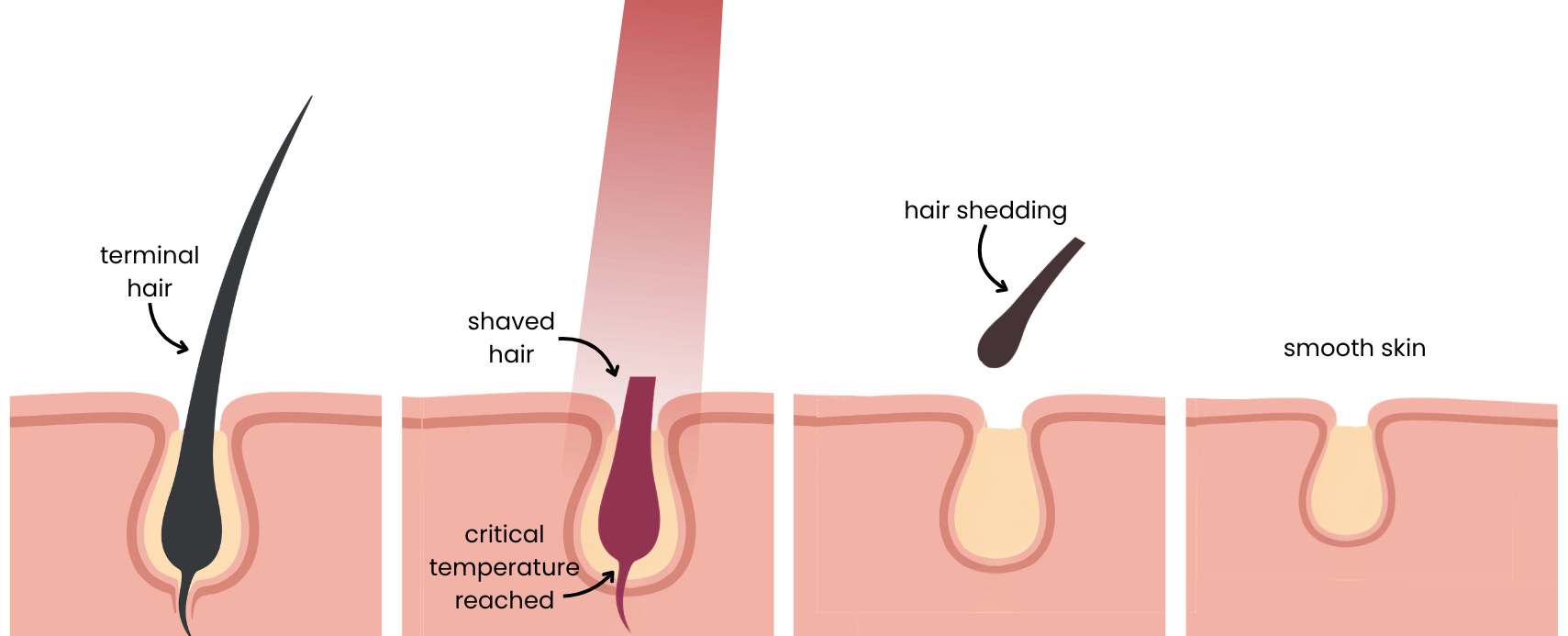
Dark skin is difficult to treat because it contains a high concentration of melanin. Skin melanin is concentrated at the surface of the skin and shields the energy from effectively passing through. In fact, research shows that over twice as much light is transmitted to the hair follicle in lighter skin (Fitzpatrick I-II) as dark skin (Fitzpatrick V-VI). This has two practical consequences:
It reduces the energy reaching the root, making photoepilation less efficient.
The heat absorbed by the skin causes discomfort and side effects including hyperpigmentation and burns.
To maximize both comfort and effectiveness for darker skin, the ViQure S-LD strikes a balance between several important factors.
Does light wavelength make a difference?
Yes — certain wavelengths bypass melanin in the skin’s surface, making them safer and more effective for dark skin.
Light travels in waves, and wavelength refers to the distance between the peaks of those waves. Humans perceive different wavelengths as different colors of light, but wavelengths extend beyond what the eye can see.
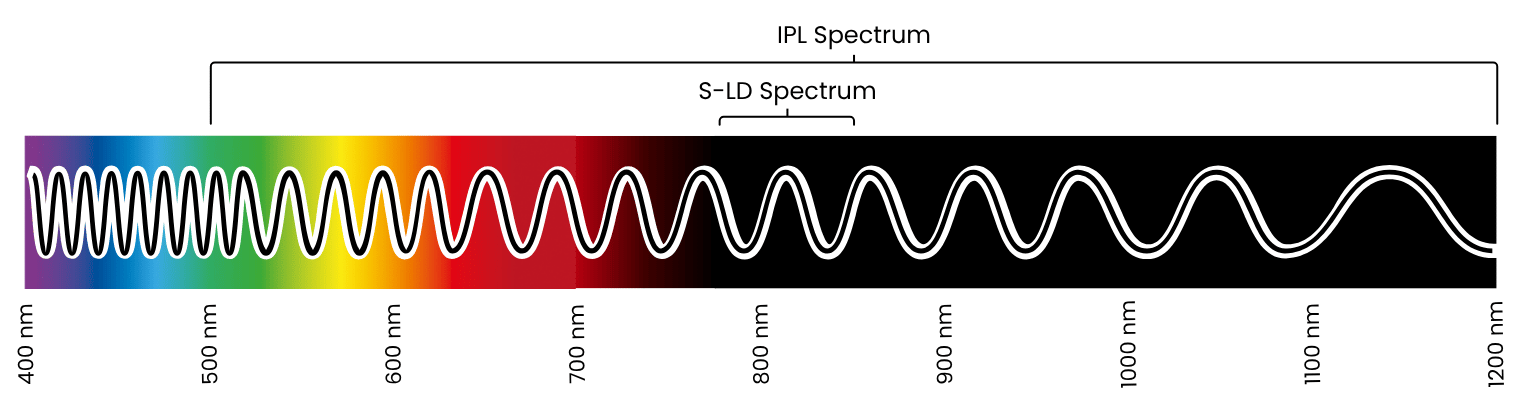
Light interacts with skin tissue differently based on wavelength. Shorter wavelengths are aggressively absorbed by melanin, which means in dark skin, they get stopped at the surface before ever reaching the hair root. Longer wavelengths, by contrast, pass through that surface layer far more efficiently. Beyond making photoepilation more effective for darker skin, devices operating at longer wavelengths carry a lower risk of Post-Inflammatory Hyperpigmentation (the dark patches that can linger after skin irritation) because less of the device’s energy is absorbed by the skin.
Why LED Matters Here: IPL devices use xenon arc lamps which inherently emit a broad-spectrum of wavelengths — usually 500-1200nm. The lower end of that range (500–700nm) is in the danger zone for dark skin: those shorter wavelengths are aggressively absorbed by surface melanin, increasing burn risk and hyperpigmentation. Lasers and LEDs, by contrast, emit only a narrow range of wavelengths, making them much better suited for treating dark skin.
The S-LD uses a high-power LED with a native emission of 780–850nm — squarely in the “therapeutic window” where wavelengths are long enough to bypass surface melanin but short enough to be effectively absorbed by the hair follicle. This delivers safer and more effective photoepilation for dark skin users.
Is higher fluence better?
Yes — but only if the device can deliver it safely without burning darker skin.
Fluence is the dose of energy a device emits, measured in J/cm². Most at-home devices operate at the lower end of effective fluence ranges. On lighter skin with ideal hair characteristics, this is sufficient, since little energy is lost to surface melanin before reaching the follicle. On darker skin, since surface melanin absorbs a meaningful portion of that energy, a device that is borderline effective on light skin may fall short of the effective threshold on darker skin. The catch: simply increasing fluence is not a safe solution on its own — that higher starting dose has to be delivered without burning the surface that absorbs it.
Consumer IPL devices already operate at low fluences, typically up to 6–7 J/cm² at peak. To manage burn risk on darker skin, most include skin tone sensors that automatically throttle energy output further when higher melanin is detected. This is a necessary safety measure, but it compounds the fluence problem: a device that is already borderline delivers even less energy to the skin. At worst, consistently sub-threshold fluence can trigger Paradoxical Hypertrichosis — stimulating hair growth rather than suppressing it.
A handful of at-home diode lasers do reach higher fluences, but they either lack skin cooling (making them painful to use) or cost significantly more.
How the S-LD closes the gap: At 25 J/cm², the S-LD does not throttle its output for darker skin. The safety margin comes from wavelength and cooling, not from reducing the energy dose. Additional features — which we will cover after the upcoming video — make it even more effective at delivering that fluence.
But don't just take the spec sheet's word for it.
Empirical proof: the “Hair Test” experiment
To see if the ViQure S-LD actually delivers the thermal energy required to denature hair protein, I ran an experiment on a swatch of my own hair taped to a notebook. I set the device to the highest setting (25 J/cm²) and fired a single pulse. The result was instantaneous. The hair wasn't just singed — it was totally carbonized.
The takeaway: Most at-home devices (especially budget IPLs) simply don't have the punch to cause this level of thermal damage to hair. If the S-LD can do this to a swatch of hair on paper, it has a fluence that is high enough to achieve permanent hair reduction.
What is pulse duration and why does it matter?
Pulse duration is the length of time a single pulse lasts, measured in milliseconds (ms). According to research, pulse duration is one of the key safety factors when treating dark skin.
The principle bridging dark skin safety and pulse duration relies on how quickly different tissues cool down. Hair holds onto heat better than skin, and this difference creates an opportunity: a slightly longer, gentler pulse can gradually heat the follicle to its “kill” temperature while the skin surface sheds heat along the way and never reaches a dangerous temperature.
For darker skin, this distinction is critical. A short, intense burst does not give the skin time to cool, resulting in a painful experience and even burns.
The Optimization: IPL devices fire a short, sharp pulse, with a pulse duration that is usually under 10ms, because their flashlamp technology releases energy in one quick burst — they simply cannot produce a long, gradual pulse. By contrast, the way that LEDs are controlled allows the S-LD to emit a 95ms pulse — long enough to exploit the thermal relaxation difference between hair and skin.
How skin cooling improves safety
Cooling creates a thermal buffer that protects the skin's surface while the follicle heats up. Without it, high fluence would burn dark skin.
Wavelength, fluence, and pulse duration all govern how light behaves. Cooling governs how the skin responds. It is the only factor focused entirely on protecting the skin’s surface rather than optimizing the light itself.
The S-LD’s contact surface — the plate with the treatment window that contacts your skin — has built-in active cooling. As the device delivers its pulse, the cooling system continuously pulls heat away from the skin’s surface. This creates a thermal buffer: the follicle still receives the energy it needs, but the skin above it stays significantly cooler than it would otherwise.
For darker skin, this buffer is essential. Without active cooling, the high fluence required for effectiveness would overheat surface melanin, causing discomfort or injury. With cooling, the same fluence becomes safe and tolerable.
Final Verdict
So — is the ViQure S-LD actually effective for dark skin?
Based on what I found in the clinical literature, the FDA filing, and my own use: yes, the S-LD is uniquely designed to be both comfortable and effective for Fitzpatrick IV and V users. The combination of a 780–850nm wavelength, 25 J/cm² fluence, long pulse duration, and active contact cooling addresses the main factors that make standard devices unsafe or ineffective for dark skin. No other at-home device in this price range currently hits all four.
However, it’s important to note that Fitzpatrick VI skin is excluded — the device specifications warn against it. And like all photoepilation, it works on pigmented hair only, which means grey or very light hair is out of scope regardless of skin tone.
I used this device for my own hair removal journey where I experienced over 70% reduction in hair growth after three treatments. I document my experience here: ViQure S-LD Results: Timelines, Tips, and What to Expect.
Out of the many devices on the market, the ViQure S-LD is one of the few that actually delivers results for brown skin. If you have Fitzpatrick IV or V skin, this is the one I recommend.
BONUS: How LED hair removal actually works (for the nerds)
This section is for curious minds who want to know what is actually happening under the hood. It is a brief summary of the research and knowledge that convinced me to buy the S-LD for myself.
LED-based hair removal is the “new kid on the block” of the at-home photoepilation world and has shown recent success in clinical evaluations, particularly for treating darker skin tones. The engineering challenge: packing enough intensity into a handheld device while maintaining safety.
Thermal Management: How 25 J/cm² is Possible
The Challenge: Historically, LEDs lacked the power density for permanent hair removal due to thermal droop, a physical law where light output plummets as soon as the LED heats up.
The Engineering Solution: Modern LEDs close the performance gap through internal pathways that move heat away from the light-producing center far more rapidly. Pairing these high-output chips with advanced thermal substrates, such as ceramic bases and metal-core boards, manufacturers are able to keep the electronics stable even under massive electrical loads.
Beam Control and the “Optical Bridge”
The Challenge: Unlike professional-grade lasers, both IPL and LEDs naturally emit incoherent light — photons leaving the light emitting surface are not in lockstep. A common misconception is that this incoherence itself prevents the light from penetrating deeply. In reality, once light enters skin, even a laser beam scatters and becomes incoherent. The real issue is divergence caused by the incoherence: when light rays travel at wide angles, they get absorbed by the skin or reflected away before reaching the follicle. Additionally, when light passes from air into skin, the change in medium can cause significant reflection.
The S-LD has two solutions to this:
The Solution (Reflector): The S-LD uses a reflective tube (visible through the lens) to gather scattered light and focus it into a narrow beam — about 15° divergence. This concentrates the light enough to significantly reduce reflection.
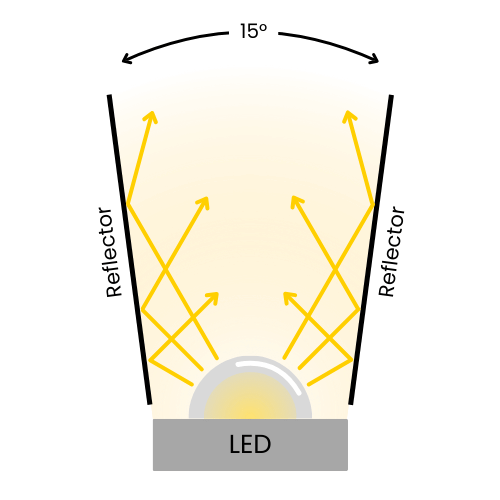
How Reflectors Focus LED Light The Solution (Gel): The S-LD requires ultrasound gel during treatment. Because the gel's density closely matches human tissue (refractive index matching), it minimizes reflection at the surface, allowing photons to pass directly into the skin.
The Bottom Line: The S-LD's engineering — thermal management to hit 25 J/cm², a reflector to focus the beam, and ultrasound gel to couple light into skin — is why this LED device works on dark skin when others fail.
Disclaimer: While I am an engineer and enjoy breaking down the science of how technology works, I am not a medical professional. The information shared here is based on my independent research and technical analysis intended for educational and informational purposes only. Please consult with a qualified professional before starting any new treatments.
Enjoy this article?
Follow Science Over Fluff on Instagram | Subscribe to the YouTube Channel
ViQure S-LD: Timelines, Hacks, and Real Results

Disclosure: This review began as a personal mission to find a photoepilation device that actually worked for my skin tone. I purchased the ViQure S-LD with my own money and posted my experience on Reddit. Parts of this article are borrowed from that original Reddit post and