

Light-based hair removal is one of the most widely used cosmetic procedures in the world, available in clinical settings and increasingly in consumer devices sold for home use. The premise is well-established: light energy targets melanin in the hair follicle, generates heat, and destroys the follicle’s ability to regrow hair. For most people, it works.
Paradoxical Hypertrichosis — the clinical term for increased or thickened hair growth following a light-based treatment — is what happens when it doesn’t. It appears in peer-reviewed literature, and while it is probably more common than reported case numbers suggest, the risk factors are well-characterized enough that the likelihood of this unwanted side-effect can be reduced. This article covers what the research says about why it happens, who carries the most risk, and which device and treatment choices actually matter.
One caveat: no article can tell you definitively whether a specific device will or will not cause paradoxical hypertrichosis in your case. Individual biology, skin type, hormonal status, and treatment history interact in ways that resist clean generalization. What this article can do is tell you where you sit on the risk spectrum.
Known Risk Factors for Paradoxical Hypertrichosis
Not everyone who uses a light-based device is equally likely to experience paradoxical hypertrichosis. The clinical literature points to a consistent set of risk factors:
Device fluence. For light-based devices, energy dose is referred to as fluence. The relationship between dose and outcome is not linear, it is threshold-dependent. Above a certain level, follicle destruction occurs. Below it, the follicle receives enough energy to be affected but not enough to be destroyed, and may be stimulated to grow instead. Undertreating with a hair removal device — using settings below the follicle-destructive threshold — is one of the most consistent paradoxical hypertrichosis risk factors in the literature.
Fitzpatrick Skin Type III to VI. Light interacts differently with different skin tones. Darker skin is a consistently reported risk factor for paradoxical hypertrichosis, and the reason is fairly straightforward. Hair removal devices work by targeting melanin in the hair to heat up and destroy the hair follicle. In darker skin, however, melanin in the skin absorbs some of the incoming light, competing for the same energy and resulting in energy doses to the hair follicle that are below the destructive threshold.
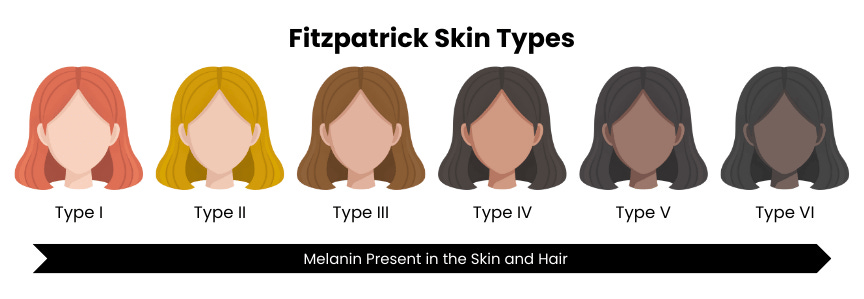
Fitzpatrick Skin Types I-VI Hair characteristics: vellus hair. Vellus hair, commonly referred to as peach fuzz, carries a higher risk of paradoxical hypertrichosis than coarse terminal hair. The reason connects back to fluence: coarser hair has a higher concentration of melanin than fine hair, so it absorbs light energy more efficiently and reaches the follicle-destructive threshold at lower device settings. In practice, this means the same device settings that would destroy a coarse dark follicle may only stimulate a fine one.
Treatment area: face, neck, and jawline. These areas have greater hormonal sensitivity than the legs or underarms. Paradoxical hypertrichosis is documented far more frequently in facial treatments than body treatments, even with identical devices and settings. One study found the prevalence of paradoxical hypertrichosis when treating facial hair to be 16.2% in women with Fitzpatrick skin tones of III and IV.
Biological sex and hormonal conditions. Certain hormonal conditions including Polycystic Ovarian Syndrome (PCOS) are a consistently reported risk factor for paradoxical hypertrichosis. The mechanism is not fully established, but elevated androgen levels are associated with increased follicle sensitivity and hair growth activity. Men produce substantially higher androgen levels than women by default, which likely contributes to a finding that tends to get buried in the literature: men appear to be at higher risk for paradoxical hypertrichosis than women. A 2025 review found that males exhibited a markedly higher paradoxical hypertrichosis incidence than females, and that in men, paradoxical hypertrichosis was not confined to the face but appeared across the back, shoulders, and upper arms as well.

These risk factors likely compound in practice. Someone with Fitzpatrick IV skin treating fine facial hair on a low-fluence device is stacking several of them simultaneously.
How to Apply This Framework to At-Home Photoepilation
Even with one or more risk factors, device selection and treatment technique can meaningfully reduce your risk.
Choosing a Device
Consumer photoepilation devices are intentionally designed with lower energy limits than clinical machines — a safety measure for untrained users that also narrows the margin between effective and subtherapeutic treatment. Choosing an at-home device that maximizes the efficiency of energy delivery to the hair follicle can help to reduce paradoxical hypertrichosis risk.
Fluence. Since low fluence is a primary trigger for paradoxical hypertrichosis, the goal is a device capable of reaching the follicle-destructive threshold in the first place. Maximum fluence varies considerably across consumer devices and is worth checking before you buy.
Built-in cooling. Contact cooling protects the epidermis while energy passes through the skin to the follicle. Beyond comfort, it has a practical benefit: adequate cooling allows you to treat at higher settings without exceeding your pain threshold, which keeps treatment out of the subtherapeutic range.
Light source. Laser and LED-based devices concentrate their output at wavelengths that penetrate beyond the surface layer of the skin, allowing energy to reach deep-seated hair follicles directly. IPL spreads energy across a broad spectrum, and certain wavelengths in that spectrum get absorbed by melanin in the epidermis before reaching the follicle — effectively warming the skin surface rather than reaching the target. For medium to dark skin, where epidermal melanin density is higher, this surface absorption is more pronounced. Since consumer devices already operate at relatively low fluences to begin with, there is minimal headroom for that kind of energy loss. A laser or LED source ensures what little energy is available actually reaches the follicle.
Related reading: The best device for brown skin (up to Fitzpatrick V)
Power throttling. Many modern photoepilation devices feature skin-tone sensors that automatically “throttle” or lower the energy output when they detect darker skin. While this prevents burns, it may inadvertently drop the fluence into the stimulation zone, thereby increasing the risk of paradoxical hypertrichosis. If you have darker skin and plan to treat high-risk areas, this is worth checking in the device specs before buying.
Treatment Technique
Do not treat peach fuzz. Vellus hair should not be treated with any light-based device, regardless of skin tone, device type, or other risk factors. This is one of the few hard rules in photoepilation: if the hair in a treatment area is predominantly peach fuzz rather than coarser terminal hair, the area should be skipped entirely.
Avoid high-risk areas if you have other risk factors present. Facial hair has the highest documented paradoxical hypertrichosis rates in the literature, and risk compounds when additional factors are present — darker skin tone, hormonal conditions such as PCOS, or a low-fluence device. For men, the back and shoulders carry the same elevated risk, likely due to androgen-driven follicle sensitivity.
Wear sunscreen, avoid tanning. A tan temporarily increases epidermal melanin, recreating the same competition for energy that makes photoepilation riskier and less effective in naturally darker skin tones. Tanned skin absorbs more of the device’s energy at the surface, which can push follicle-level fluence below the destructive threshold. Applying sunscreen to treated areas between sessions is the straightforward way to avoid this.
Stop immediately at the first sign of increased growth. Paradoxical hypertrichosis is easier to manage when caught early. Continuing treatment after noticing increased hair density or thickness risks compounding the effect. If hair growth does not reverse after discontinuation, electrolysis is the best established fallback.
The Bottom Line
Paradoxical hypertrichosis is a real phenomenon that is more common than the published case literature reflects. However, the risk factors are consistent and well-characterized enough to act on. The device selection criteria and treatment techniques covered in this article are the most practical way to apply that information.
Disclaimer: While I am an engineer and enjoy breaking down the science of how technology works, I am not a medical professional. The information shared here is based on my independent research and technical analysis intended for educational and informational purposes only. Please consult with a qualified professional before starting any new treatments.
Enjoy this article?
Follow Science Over Fluff on Instagram | Subscribe to the YouTube Channel
ViQure S-LD Tech Review: The Best Device for Brown Skin

For anyone with brown skin (Fitzpatrick IV–V), the at-home permanent hair removal market often feels like a collection of compromises. Most consumer devices rely on intense pulsed light (IPL), a technology that emits a broad rainbow of light that is not optimized for safety on darker skin tones.