

Ulike makes three IPL devices and the differences between them are not obvious from the product pages. The Ulike X is their most expensive model, the Air 4 is the newer replacement for the Air 3, and the Air 10 sits in the middle on price and is the only device in the lineup with SHR mode. If you are trying to figure out which one is actually worth buying, this article is a guide on choosing between them. It also covers who should skip these devices based on what I found testing it on my own skin.
I’m a mechanical engineer, and I’m writing about the Air 10 because the Dual Light architecture is genuinely interesting from an energy delivery standpoint. This article goes into the science of photothermolysis and includes a breakdown of SHR mode, SkinSensor, and Dual Light Architecture. There are also five weeks of real results from a friend, Tess, with near-black hair on Fitzpatrick II to III skin who tried the Air 10.
If your skin is on the darker end of the device's rated range, the SkinSensor section is worth your attention.
Note: Ulike sent me the Air 10 at no cost for review purposes. If you find the content in this article to be helpful, you can support articles like this one by using the links and discount codes found here when making your purchase. Science Over Fluff earns a commission at no extra cost to you. Additionally, as an Amazon Associate, I earn from qualifying purchases. My friend’s name has been changed at her request.
Table of Contents
Ulike Air 10, X, and Air 4: Spec Comparison

IPL is best suited for those with pale skin and dark brown to black hair. While it can work for some slightly outside of that range as indicated by the “⚠️” symbol in the table, it is less effective and results will take longer.
Quick Summary
Below is a quick guide on how to choose between the three devices:
Get the Ulike Air 10 if:
✔ You have pale skin and dark hair
✔ You prioritize faster treatment times
✔ You want the most pain-free experience
✔ Your treatment areas are darker or have uneven skin tone
Get the Ulike Air 4 if:
✔ You have pale skin and dark hair
✔ You are looking to treat stubborn hair
✔ Cost is your primary constraint
✔ You want the highest fluence of the 3 devices
Get the Ulike X if:
✔ You have pale skin and dark hair
✔ You are looking to treat stubborn hair
✔ You want to purchase the highest intensity device in this lineup
How does IPL hair removal work?
All light-based hair removal relies on a process called selective photothermolysis. The principle is relatively straightforward: the device emits light aimed at the target treatment area. Certain wavelengths of light are absorbed much more readily by melanin, the pigment in skin and hair. When melanin absorbs that light, it converts to heat. Hair generally has a higher concentration of melanin than the surrounding skin tissue, so it absorbs much more of that heat; enough heat traveling to the hair follicle root destroys the cells responsible for regrowth.
However, heat absorbed by the skin rather than the hair leads to discomfort and, at high enough energy levels, even burns. This is why contrast matters. Since pale skin has very little melanin and dark hair has the most, this combination produces the best results because the light energy goes preferentially into the hair rather than the skin. This means more follicle damage and less heat to surrounding tissue.
The skin-hair contrast is particularly important for IPL because certain wavelengths of light that IPL devices emit are especially prone to being absorbed by skin melanin. This is the reason traditional IPL is generally not recommended for darker skin tones. I cover this in more detail in my article, Why At-Home IPL Doesn’t Work for Dark Skin: The Physics of Melanin.
However, there are ways to improve the comfort and performance of IPL devices. Ulike partially addresses the wavelength problem with the SkinSensor and SHR modes, both of which improve comfort and safety when treating darker skin. Both technologies are featured in the Air 10, only the SkinSensor is featured in the X, and the Air 4 has neither.
How does SHR Mode increase comfort?
SHR mode, available in the Ulike Air 10, is the technique used in professional salon machines, where multiple low-intensity flashes build heat in the hair gradually, allowing the skin to cool across a full pulse. Hair retains heat better than skin, so a slower build-up allows skin to dissipate heat while the follicle accumulates enough heat to cause damage. This results in improved comfort and a reduced “rubber band snap” sensation compared to a single high-intensity flash.
The Ulike Air 10 uses two xenon arc lamps that fire up to two times each (up to 4 flashes) as a single combined pulse, producing up to 26J of energy across the four flashes. The 6.67 J/cm² fluence figure in Ulike’s specs represents the full four-flash burst, not each individual flash; each flash delivers only a fraction of that energy on its own. The fluence and frequency of flashes for the Air 10 is notably slightly below what salon machines typically use in SHR implementation. However, what reconciles this is the device frequency of use. The Air 10 is designed for three sessions per week over several weeks, whereas salon treatments are spaced weeks apart. More frequent lower-dose sessions accumulate comparable follicle damage over time, and the results in the last section of this article bear that out.
That being said, while SHR mode leads to a more comfortable experience, there is one drawback worth bearing in mind. Finer hair tends not to absorb or hold on to heat as well as thicker hair, so SHR mode is less effective for treating areas with finer hair such as the arms.
A word of caution: Laser, IPL, and LED hair removal does not work on peach fuzz. At-home devices should only be used on areas where you have terminal hairs. Read more: Can At-Home Laser, LED, or IPL Hair Removal Cause Unwanted Hair Growth?
The slow-motion video below plots the Air 10’s flash timing across one pulse against a modeled hair temperature curve. Temperature values are illustrative rather than measured; the exact hair temperature depends on follicle depth, hair coarseness, and skin tone. What the graph shows is a representation of the temperature of the hair: four distinct peaks with partial cooling between flashes, not a flat sustained dose and not a full return to baseline.
Can Ulike devices be used on dark skin?
Another comfort-improving feature, the Ulike SkinSensor, is available for both the Ulike Air 10 and Ulike X — but it’s a feature I’m skeptical about. It reads skin tone before each flash and reduces fluence on darker skin to stay within safe limits. This is the correct behavior; a fixed-fluence device would carry a much higher burn risk on treatment areas that are darker due to skin melanin absorbing heat from the pulse. However, reduced fluence has two practical consequences: the device produces results more slowly, and the risk of paradoxical hypertrichosis (also known as paradoxical hair growth) increases.
Though relatively uncommon, paradoxical hypertrichosis is a documented phenomenon where light exposure that is not sufficient to disable hair follicles ends up stimulating the hair instead, causing hair to regrow darker and coarser. The risk is highest on the upper lip, chin, and jawline for women and back, shoulders, neck, and upper arms for men. One study found the prevalence of paradoxical hypertrichosis to be as high as 16.2% when treating the face. Those with hormonal conditions such as PCOS as well as those medium to dark brown skin are also at greater risk. I cover the mechanism and risk factors in detail in my paradoxical hypertrichosis guide. The short version: using these devices on areas with coarse hair such as the legs and underarms is significantly less likely to produce this undesirable side effect. However, especially if you have one or more risk factors, I would not recommend using photoepilation devices in any high-risk areas (face, neck, shoulders, back, and upper arms).
If your skin is on the lighter end of Fitzpatrick IV and you’re wondering if this device can still work for you, there are certain factors that may play in your favor. Using the device on places with medium to thick hair such as legs or underarms may still produce results, but results will take more time and repetition. In general, thicker and darker hair, shallower roots, and paler skin all contribute to faster and more permanent results.
As for Fitzpatrick V skin, though Ulike does say that the Air 10 will be safe to use, I would really temper expectations regarding getting results due to the throttled power being so low. In my view, Ulike’s SkinSensor feature is most useful for those with generally pale skin who are concerned about treating areas that are slightly darker or have uneven pigmentation, not for those with darker skin everywhere.
The video below shows the SkinSensor’s power bar output on my Fitzpatrick IV skin alongside an example of the power bar for Fitzpatrick II skin. The power bar visibly drops on my skin. That is the device working as designed, but it also shows exactly why results will differ.
If you’re looking for a device recommendation for Fitzpatrick IV or V skin, try this tool designed to route you to a device that best matches your physiology and goals:
Ulike Air 10, Air 4, and X: How do the three devices compare?
The core difference across all three devices is how the energy is distributed per trigger. The Air 10’s SHR mode breaks 26J into four flashes, keeping each individual flash at a lower intensity. The Air 4 and Ulike X both use two flashes per pulse instead, which means higher intensity per flash. The Air 4 delivers 24J across those two flashes while the Ulike X delivers 26J via Dual Light.
In practice, higher intensity per flash means more heat absorbed by the skin, which is less comfortable. The tradeoff is that high intensity flashes are also more effective on hair that is finer or deeper-rooted, where more instantaneous energy is needed to build up heat and reach the follicle. For most standard body areas, the Air 10’s four-flash approach reaches the same cumulative dose with a gentler experience.
Beyond energy distribution, the Air 10 and X models have a treatment window 18% larger than the Air 4, which reduces session time on larger areas. However, the Ulike X costs more than both other devices, and with only a 2J energy advantage over the Air 4 and no window size advantage over the Air 10, the case for it is narrow.
Five weeks of real results: Does the Air 10 actually work?

Tess has pale skin with near-black hair, a profile close to the maximum melanin contrast, ideal for IPL. She treated her underarms three times per week for the first five weeks, using SHR mode on High with AutoGlide throughout. AutoGlide mode is exactly what it sounds like: it allows you to glide the window of the device over your skin while the device pulses continuously.
Her first week, she was tentative. She described being anxious about coverage, worried about overlapping with the previous flash or leaving gaps each time she moved the device. That hesitation likely cost her some efficacy in week one, and she discounts it herself: “I think my first week I was too cautious, so I’ve gotten a lot more aggressive and my method has improved a lot.” In the following weeks she went over each area up to three times per position before moving on. Ulike recommends going over each section two to four times per session, so this is consistent with their advice.
By week five the results were clear. Tess noted that while not all hairs were completely gone, regrowth had slowed visibly, the remaining hair was thinner, and shaving had become easier with less razor burn.
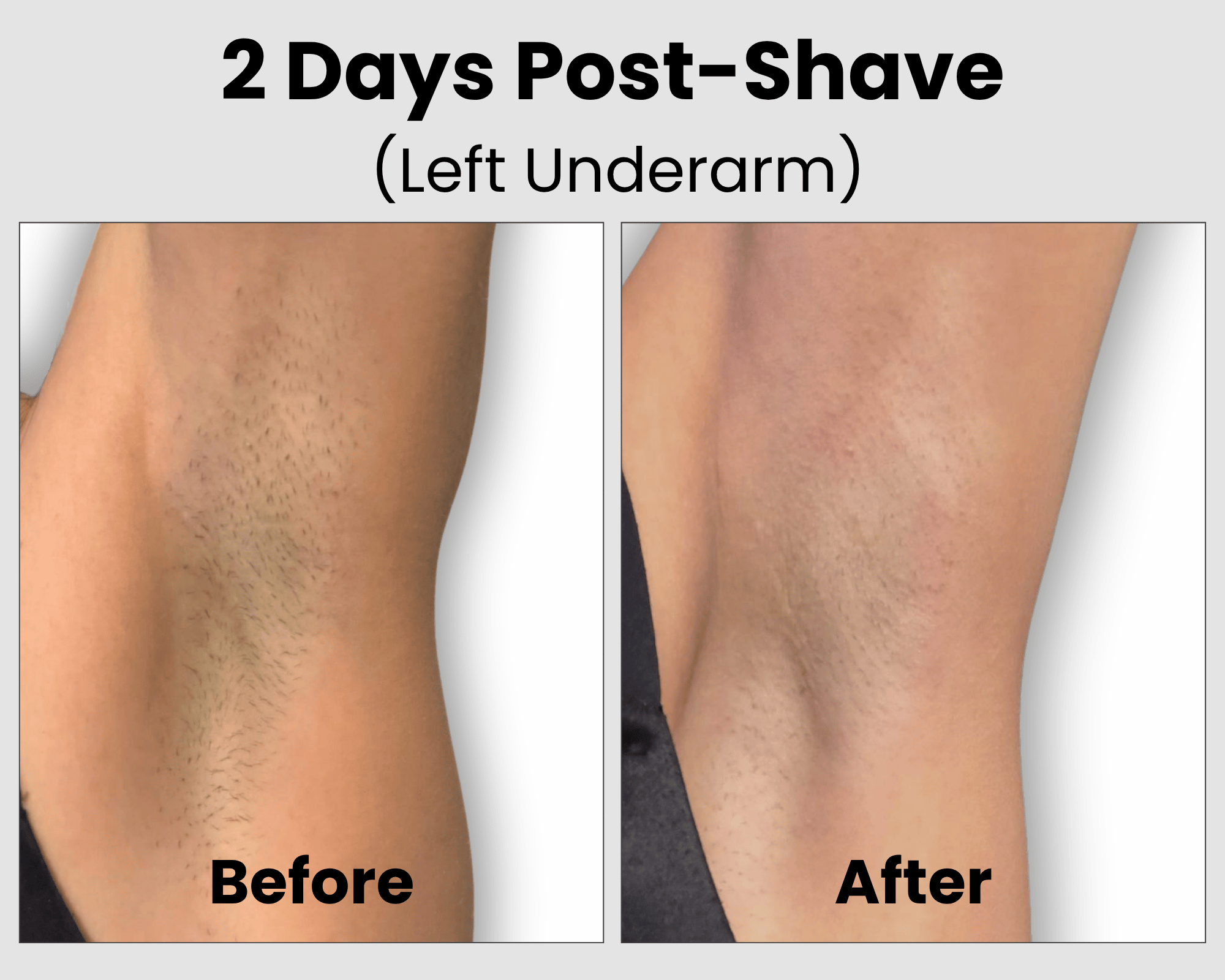
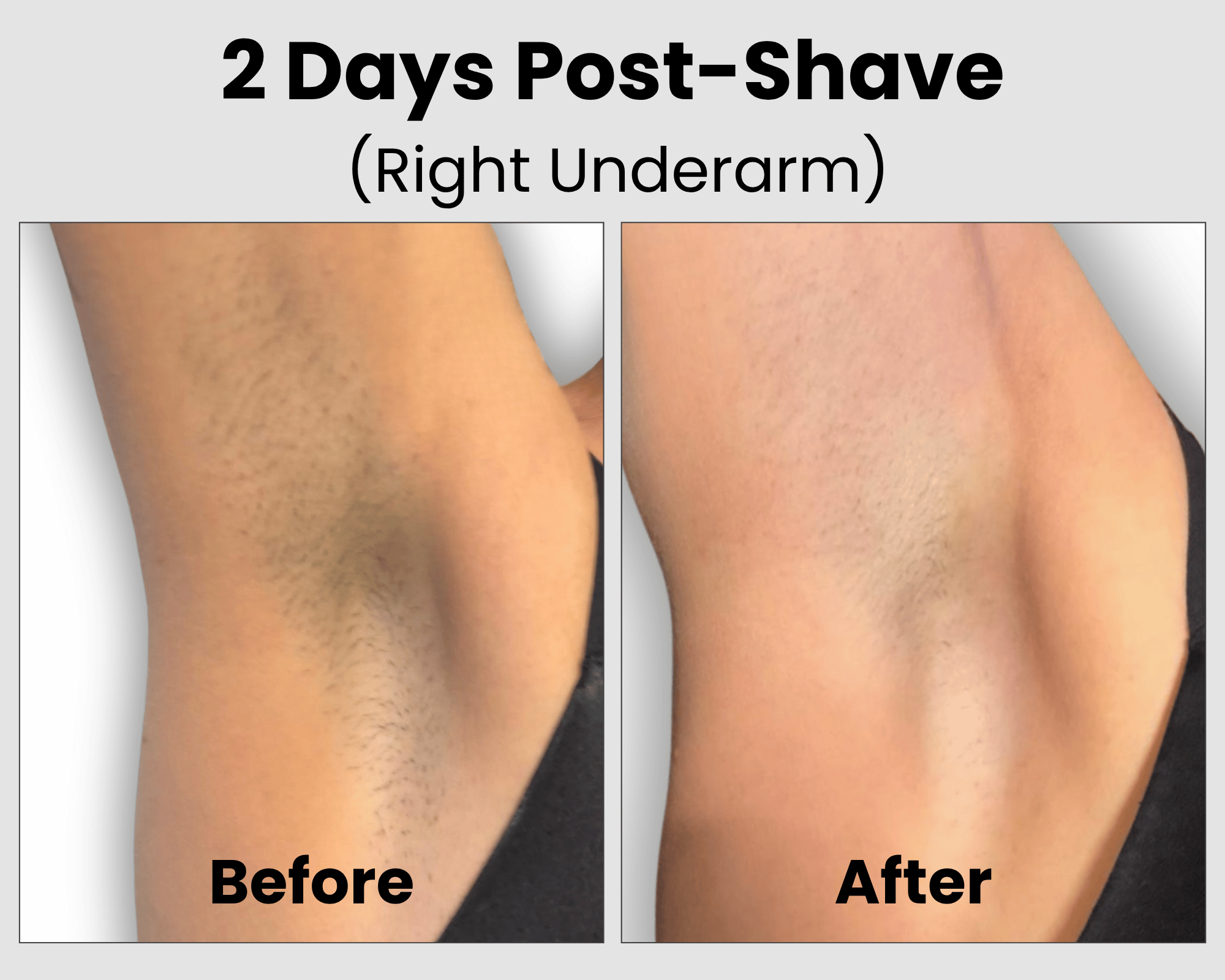
Pain was minimal throughout. Tess described the sessions as relatively painless, with occasional pinpoint burning sensations that were tolerable and became less frequent over time. She also had a mild razor burn-like sensation for a short while immediately following her initial treatments. She noted she would not want to drop below SHR on High mode given the time investment; if you are going to commit to the schedule, you want the strongest setting working for you.
She does have deep-rooted hair, which she flagged as a possible reason results took a few weeks to become obvious. That is worth keeping in mind if your hair is similar; the timeline will not be linear, and the first week or two especially may feel like nothing is happening.
Technique notes from five weeks of use
Tess noted that curved areas like the underarms take patience; AutoGlide is designed for large flat surfaces and the coverage anxiety she described in week one is real. Manual mode with deliberate placement is an alternative for smaller areas, but she stuck with AutoGlide once her technique settled.
Two things worth knowing before your first session: first, the skin contact sensor is sensitive enough that the device can fire if you lift it mid-session without expecting it to. Second, even when the window is flush against the skin, there is noticeable light leakage around the edges. Tess wears the included glasses and sometimes even closes her eyes on the flash, noting that the light is bright enough to see through closed eyelids at close range. While glasses are usually sufficient, closing your eyes or turning away may be an additional precaution when treating areas where the light can get around the sides of the glasses.
Session time settled at about 10 minutes per armpit, mostly due to Tess going over each area three times. For legs she estimated 30 minutes per calf with her current technique, which would be roughly an hour for both calves per session, three times a week for four to six weeks. “The input is a lot,” she said, “but if I get good results it would totally be worth it.” That is probably the most honest summary of what you are signing up for.
Final Verdict
The right device depends on what you are optimizing for. The Air 10 is the most comfortable and covers ground fastest. The Ulike X is more intense per pulse for stubborn hair. The Air 4 gets the job done at a lower price point.
Five weeks of data on a near-ideal candidate profile: measurably slower regrowth, visible thinning, no meaningful pain. This is not the 96% reduction in two weeks that Ulike's marketing claims — Tess still shaves. However, the reduction is real, and it matches what the physics predicts.
→ Ready to try it?
Disclaimer: While I am an engineer and enjoy breaking down the science of how technology works, I am not a medical professional. The information shared here is based on my independent research and technical analysis intended for educational and informational purposes only. Please consult with a qualified professional before starting any new treatments.
Enjoy this article?
Follow Science Over Fluff on Instagram | Subscribe to the YouTube Channel