

Quick Summary: Beard hair is deep-rooted and stubborn, so clearing it requires a device that’s powerful. In a crowded field of devices, the standout is the ViQure EpiPro: a genuine 808nm diode laser that delivers the highest energy of any home device on the market.
Facial hair is a personal matter, and while many trans women are content to keep their beards, others would prefer it gone. This guide is for those who’ve decided on the latter and are weighing how best to go about it.
Beard hair can be unfortunately persistent to remove: estrogen and anti-androgens thin it over time, but they won’t completely clear a beard that’s already grown in. That existing hair is what laser hair removal or electrolysis addresses. Electrolysis can remove hair permanently, and laser delivers lasting reduction. However, both options are expensive, which is why home lasers have become increasingly prevalent in the past several years. Home devices typically cost far less than a full round of clinic treatments, they’re a one-time cost rather than per-session billing, and can be used on your own schedule and in your own space. The difficulty is that beard hair is among the hardest on the body to remove, and most at-home devices aren’t built for it. This article discusses why beard hair is so hard to address with laser hair removal, the reasoning behind why the ViQure EpiPro is one of the strongest at-home options out there, and how HRT changes the picture.
Note: If you find the content in this article to be helpful, you can support future articles like this one by using the links and discount codes found here when making your purchase. Science Over Fluff earns a commission at no extra cost to you. Additionally, as an Amazon Associate, I earn from qualifying purchases.
Why is beard hair so hard to remove at home?
All light-based hair removal works through a process called selective photothermolysis: the device emits light, the melanin (pigment) in your hair absorbs it, and that light energy converts to heat which “cooks” the follicle until it’s destroyed. The catch with beard hair is where the follicle sits.
Beard hair is androgen-driven, meaning it’s hormonal, and hormonal follicles are anchored deep in the skin. To disable one for good, the device’s energy has to reach that root and still arrive hot enough to do damage. That depth is where most at-home devices fall short.
When looking for a device to treat beard hair, the real question is “can this device deliver enough energy deep enough?” Two specs answer that: wavelength and fluence.
What to look for in an at-home laser for beard hair
1. Wavelength: why lasers can reach deep beard follicles better than IPL devices
Wavelength is essentially the “color” of the light, and different wavelengths penetrate to different depths in skin. Near-infrared light sits just past the red end of what your eye can see, and it reaches several millimeters beyond the surface, right where deep hair follicles live.
IPL (intense pulsed light), the technology in most at-home devices, has a structural problem here. It fires a broad mix of wavelengths at once, spreading energy thin so the deepest follicles never get a concentrated dose. A true laser emits a single narrow near-infrared band instead, concentrating the energy where the follicle actually sits. For shallow hair such as leg hair, IPL can work well for many. However for deep-rooted beard hair, the energy often doesn’t sufficiently reach the hair roots.
2. Fluence: the parameter that decides whether results will last
Fluence is the energy density a device delivers, meaning how much light energy lands per unit of skin, and it’s the variable that decides how well your results hold up over time. Deep-rooted hair needs a lot of energy, because the heat has to survive the trip to the root and still cross the threshold that destroys the follicle. Fall short of that threshold and you only “stun” the hair: it might thin out, but it’s more likely to grow back over time. That’s the maintenance treadmill low-fluence devices put you on.
Fluence has a second payoff worth flagging early. Under-dosing, the same shortfall that leaves hair merely stunned, is also the most consistently reported modifiable trigger for paradoxical hypertrichosis: an effect where a warmed-but-not-destroyed follicle is stimulated into growing instead of shedding. That sounds alarming, but it’s well characterized and treating at an adequately high fluence is one of the clearest ways to reduce the risk. I cover the full risk picture in my guide to avoiding paradoxical hypertrichosis.
Plenty of people get real results from IPL if their hair is shallow, dark and coarse and their skin is fair. But for deep beard hair, a low-fluence device often means results that never fully arrive and many more sessions along the way.
The best at-home laser for beard hair: the ViQure EpiPro
If you are treating beard hair and want the best odds with an at-home device, you want a device that emits the correct wavelengths at a high enough fluence, and the one I would point to is the ViQure EpiPro because it checks both boxes.
It's a real 808nm diode laser, confirmed in its FDA 510(k) summary. 808nm sits in the near-infrared range, so it reaches the depth where beard roots sit. It also has a 30 J/cm² fluence, making it the most powerful home device on the market. Its contact cooling (a chilled tip held against the skin) is not just a comfort feature, it’s a practical one: it makes a high-power session tolerable enough to treat at a setting that works.
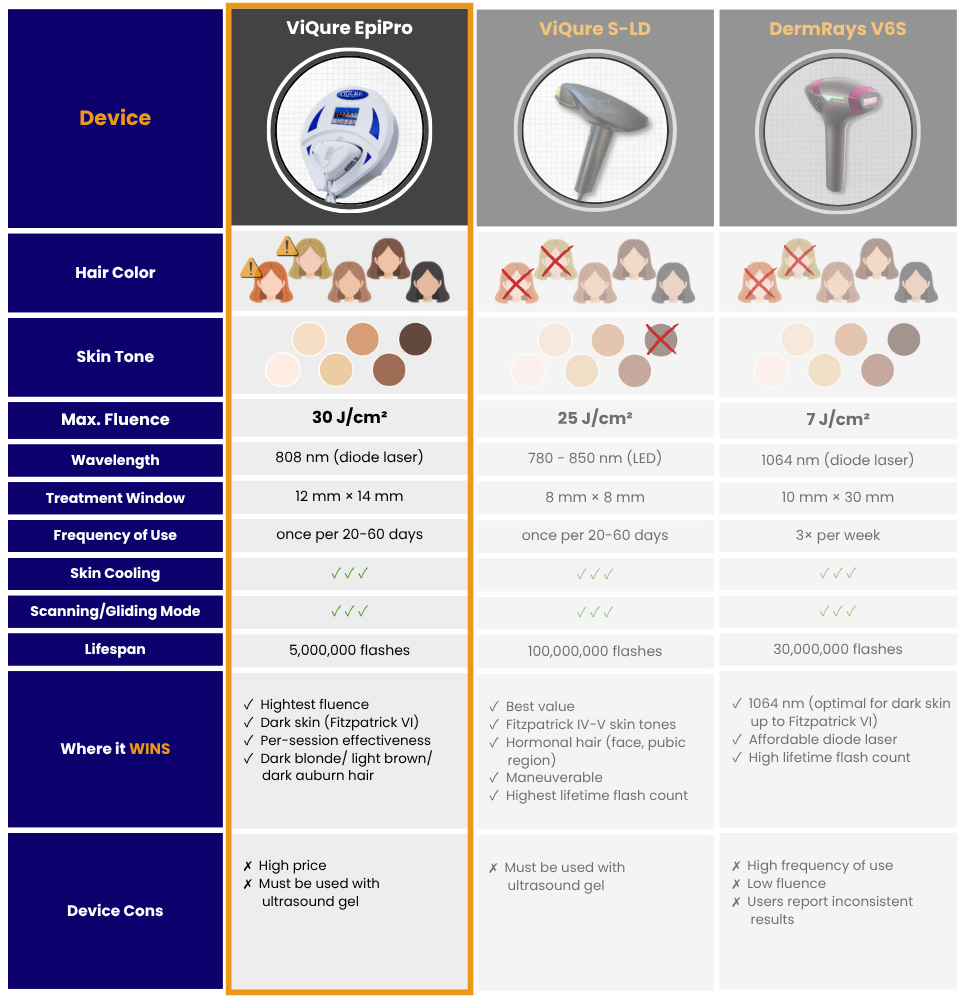
Where it excels for beard hair:
✔ The 808nm wavelength reaches deep-rooted, coarse hair follicles
✔ At up to 30 J/cm² fluence, it is approximately 5-6× more powerful than most IPL devices
✔ Contact cooling, so you can treat at an effective setting comfortably
Discount Code

Does laser hair removal work while on HRT?
This gets misrepresented a lot, so let’s be precise, because more than one thing changes at once and the changes pull in opposite directions.
Feminizing hormones suppress androgen-driven growth, and over time this thins facial hair. The research bears this out: in trans women on feminizing therapy, studies that used quantitative measures found statistically significant drops in facial hair diameter, density and length. Two of those changes matter for a laser, and they don’t point the same way.
The change that works in your favor: a follicle that thins is also a follicle that sits shallower. Follicle depth tracks follicle size closely. A full terminal beard hair is rooted about 4 to 5 mm down, with its bulb in the subcutaneous fat; an intermediate hair sits around 2 to 3 mm; a fully miniaturized one sits at less than 1 mm. So as hormones shrink a follicle, its root does climb toward the surface, and in principle a shallower root is easier for a device to reach. That much is correct.
The change that works against you: since laser hair removal relies on skin-hair contrast to work best, the conditions become less optimal as hair becomes lighter and finer. The whole mechanism for laser hair removal depends on the hair still being dark and coarse. As hormones lighten and fine the hair, the target pigment that converts light to heat gets smaller. That’s why a shallower root doesn’t rescue the treatment entirely.
There’s a second reason not to lean on the depth change. On the face, feminizing therapy usually only produces partial thinning. Facial follicles are strongly androgen-driven and largely persist: one systematic review found that only about 28% of adults on feminizing therapy report any decrease in facial hair at all, and even when testosterone was fully suppressed, facial hair growth continued while other hair and sebum measures declined. So the realistic outcome is that while hair on the face may become finer, it isn’t likely to disappear altogether.
The takeaway: your beard is the strongest laser target while it’s still somewhat coarse and dark, which means earlier in transition. That’s the window when a high-fluence device has the most to work with. For hair that’s already gone light, grey or fine, whether from hormones or genetics, laser struggles no matter the device, and electrolysis (which destroys the follicle with a fine electric current, regardless of hair color) is the reliable way to finish. The established plan for many is to let laser clear the heavy, dark hair and use electrolysis to clean up the rest.
Frequently asked questions
How many sessions does beard hair take? With the ViQure EpiPro, most people see meaningful reduction of hair in their treatment areas over four to six monthly sessions. However, facial hair is a relatively dense and stubborn treatment area, so plan for the higher end and expect it to need more sessions than other body areas.
Should I use laser or electrolysis for trans facial hair? Both, ideally. Laser efficiently clears the bulk of dark, coarse beard hair; electrolysis is the only reliable option for light, grey, or fine hair that laser can’t target. Letting laser do the bulk and electrolysis do the finish is the standard approach.
Will treating my beard early cause paradoxical hypertrichosis? It’s a real risk, and treating the face while androgens are still high stacks two of the recognized risk factors, so it isn’t one to wave off. The reassurance is that the biggest modifiable trigger is under-dosing, so using the ViQure EpiPro at one of its higher settings is less likely to trigger it. Don’t keep lasering hair once it’s thinned into fine or vellus territory; that’s the range most likely to be stimulated rather than destroyed, and it’s when switching to electrolysis is the more cautious option. Watch for hair coming in thicker rather than finer, and stop and reassess at the first sign.
Disclaimer: While I am an engineer and enjoy breaking down the science of how technology works, I am not a medical professional. The information shared here is based on my independent research and technical analysis intended for educational and informational purposes only. Please consult with a qualified professional before starting any new treatments.
Enjoy this article?
Follow Science Over Fluff on Instagram | Subscribe to the YouTube Channel