

Note: If you find the content in this article to be helpful, you can support future articles like this one by using the links and discount codes found here when making your purchase. Science Over Fluff earns a commission at no extra cost to you. Additionally, as an Amazon Associate, I earn from qualifying purchases.
If you’re searching for the best at-home photoepilation device, you’ve likely realized that most consumer-grade options are underpowered. If you have stubborn hair or a darker skin tone, the typical $400 IPL device often fails to deliver permanent results because it lacks the “punch” to actually disable the follicle.
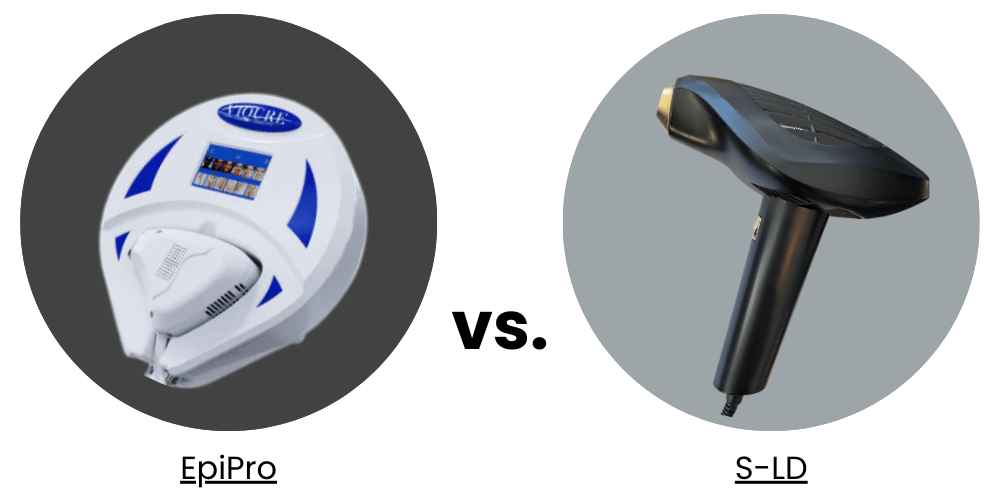
This brings most serious buyers to the two heavyweights of the at-home photoepilation world: the ViQure EpiPro and the ViQure S-LD. Both of these devices utilize aggressive intensity to mimic the performance of a professional clinic laser. Whether you are choosing between the speed of the laser-based EpiPro or the precision and lifespan of the LED-based S-LD, you are looking for a product that is the closest thing to a salon-quality device on the market. This guide is aimed at helping you decide which high-output powerhouse will work best for your needs.
Technical Specifications: At a Glance

Choose the EpiPro if:
✔ You want the fastest results (200 W)
✔ You’re seeking a device compatible with any skin tone (Fitzpatrick I - VI)
✔ You’re treating black, brown, dark blonde, or dark auburn hair
✔ You prioritize covering large treatment areas quickly
✔ You’re searching for a true diode laser-based device
Choose the S-LD if:
✔ Your skin tone is pale to medium-dark (Fitzpatrick I - V)
✔ You have black or brown hair
✔ You have a smaller budget
✔ You need a more portable device
✔ You are looking for an LED-based device
✔ You need better maneuverability and precision around intricate features
Discount Codes
Get a good deal and support content from Science Over Fluff at the same time by using the links and discount codes in this article to make your purchase. Science Over Fluff earns a commission that funds articles like this at no additional cost to you.


Frequently Asked Questions
How do I use the S-LD and EpiPro?
ViQure S-LD: ViQure S-LD User Manual
ViQure EpiPro: ViQure EpiPro User Manual
Does high fluence matter?
Yes. Fluence is one of the primary factors that determine how permanent your results are. In the world of hair removal, “fluence” is the term for a device’s energy density. Essentially, it is the amount of intensity the light carries to deliver heat to your hair follicle. If you don’t hit the hair root with a high enough concentration of energy, you only stun the follicle temporarily instead of destroying it. This is why many low-powered consumer devices require constant “maintenance” sessions; the hair isn’t gone, it’s just paused. High fluence is the difference between hair growth that merely takes a month-long break and true permanent hair reduction.
Is the ViQure S-LD Actually Effective for Hair Removal?
Yes. The S-LD was actually my personal device choice for at-home hair removal and I had significant reduction in hair growth in all areas that I treated by my third session, with some areas even responding after session 1.
Read more:
ViQure S-LD: Timelines, Hacks, and Real Results

Disclosure: This review began as a personal mission to find a photoepilation device that actually worked for my skin tone. I purchased the ViQure S-LD with my own money and posted my experience on Reddit. Parts of this article are borrowed from that original Reddit post and
Is the ViQure EpiPro Actually Effective for Hair Removal?
Yes. While I personally used the S-LD, the EpiPro’s specs, specifically the 808nm diode and 30 J/cm², are the industry gold standard for clinical results. If you have the budget for the extra power, the physics confirms it will be the more efficient tool for permanent hair reduction.
Most consumer IPL devices are underpowered, peaking at about 5–7 J/cm². This is often enough to “stun” the hair, but it rarely hits the critical thermal damage threshold required to permanently disable the follicle. The EpiPro, by contrast, delivers up to 30 J/cm². This energy density ensures that the target is actually destroyed.
Beyond a high fluence, the EpiPro mirrors professional salon machines by covering more skin per flash and allowing you to control how long each burst of energy lasts. According to feedback from the user community, the pace of reduction is consistent with what you would expect from getting professional laser hair removal at a clinic.
→ See more about the ViQure EpiPro
Is the ViQure EpiPro a real diode laser?
Yes. The EpiPro uses a real diode laser for hair removal, which is fundamentally the same technology found in professional medical-grade hair removal systems. This is confirmed in the FDA 510(k) Summary for the EpiPro, under the “Device Description” section, where it states that the device “utilizes a semiconductor diode as a laser source (808nm)”.
→ See more about the ViQure EpiPro
Which device hurts less?
While neither device is especially painful to use, don’t let “painless” marketing fool you. Effective photoepilation is rarely a completely comfortable and pain-free process because the results are driven by heat. To disable a follicle, you have to get it hot enough to sustain damage. As a general rule, if you're not feeling anything at all, your session is probably not going to be as effective. Each flash should feel like a light to medium rubber-band “snap”, though the sensation should not be unbearable.
That being said, both the S-LD and EpiPro were designed with comfort in mind, featuring integrated cooling and pulse delivery systems that help mitigate the “thermal snap” of the light. Between the two devices, the EpiPro gives you more adjustability in this domain. Because it allows you to change the pulse frequency (Hz), you have direct control over how that heat is managed.
Does LED hair removal actually work?
Yes. The S-LD is an LED-based hair removal device. Photoepilation using LEDs is a newer technology that has proven highly effective. The full technical breakdown is in my S-LD review, but the short version is this: your hair follicles respond to specific wavelengths of light and heat, and the source that produces those wavelengths, whether a laser diode or an LED, does not change how the follicle responds.
Read more:
ViQure S-LD Tech Review: The Best Device for Brown Skin

Disclosure: Transparency is a core value at Science Over Fluff. This project originally began when I posted a raw, unsponsored review on Reddit after purchasing the ViQure S-LD with my own money for personal use. Parts of this technical analysis are borrowed from that original Reddit post and
What makes the ViQure S-LD and EpiPro safe for dark skin?
Photoepilation on dark skin is inherently challenging because the high levels of melanin in the skin absorb heat, which can reduce treatment effectiveness and increase the risk of burns. However, it is possible to engineer a device to mitigate these risks. There are three primary factors that determine device safety for dark skin: wavelength (i.e. light “color”), pulse duration, and active skin cooling.
Wavelength: Certain wavelengths of light penetrate deeply into the skin and resist getting absorbed as heat by melanin. This allows the energy to bypass surface-level melanin and target the hair root more directly.
Pulse Duration: Because hair retains heat better than skin, using a pulse that delivers energy at a slightly lower intensity over a slightly longer duration can give dark skin enough time to cool while the hair gradually reaches the required temperature for destruction.
Active Skin Cooling: A chilled contact tip that stays in direct contact with skin can help prevent burns. This constant cooling pulls heat away from the epidermis in real-time as the light passes through, creating a safety window that allows for high-fluence treatments on darker skin.
Both the S-LD and EpiPro are engineered to balance these three factors, providing a professional-grade treatment that remains safe for users higher on the Fitzpatrick scale.
Read more:
Why At-Home IPL Doesn't Work for Dark Skin: The Physics of Melanin

Note on Terminology: While I sometimes use the term "permanent hair removal", which is often used in casual conversation, I am actually referring to “permanent hair reduction” as classified by the FDA. Per FDA guidelines, photoepilation (laser, IPL, and LED hair removal) is officially classified as “permanent hair reduction” which refers to a stable, lo…
Does the EpiPro work on blonde or red hair?
The short answer is: it depends. Photoepilation typically struggles with lighter hair colors because there isn’t enough pigment (melanin) for the light to “target” effectively.
However, at 30 J/cm², the EpiPro is significantly more powerful than the average at-home device. That higher energy density means that if your hair is a darker shade of blonde or auburn, the EpiPro has a better chance of reaching the thermal threshold needed for follicle damage than other at-home options. You should still expect that your results will be less dramatic than someone with black or brown hair, and you will likely need a higher number of treatments to achieve results.
Do I have to wear eye protection?
Yes. Both the S-LD and EpiPro emit concentrated light that can be harmful to your eyes, whether from a direct flash or a strong reflection off a surface.
Always use the safety glasses provided with your device. They are specifically rated to filter the wavelengths emitted by these machines, ensuring you aren’t straining or damaging your eyes during a session.
What happens if I miss a session?
Performing a session a few days late won’t ruin your progress, but going too long between sessions may delay your final results. Photoepilation is only effective when hair is in the anagen (active growth) phase. During this specific window, the hair shaft is physically connected to the root. The light uses the hair shaft as a path to conduct heat down to that root; when the two are no longer connected, the energy cannot reach its target.
Because your hair follicles operate on independent schedules, only a fraction of the hair in any given area is in this phase at one time. Consistent sessions are designed to catch each group of follicles as they rotate into the anagen stage. If you skip too many weeks, you may miss a significant growth cycle, meaning you’ll need more sessions later to catch the follicles you missed.
Will the S-LD or EpiPro work on my face and bikini area?
Yes. Both devices are significantly more effective for those areas than standard IPL. Because the face and bikini area often have deeper, more stubborn roots, the focused energy of both the S-LD and EpiPro penetrate much further than the broad-spectrum light of an IPL device. This leads to faster results and fewer missed hairs in these high-priority spots.
S-LD: This device is slightly more compact and maneuverable, which makes it easier to navigate the tight contours of the upper lip or the bikini area. If you are focused on precision and ease of handling in small areas, the S-LD is a great fit.
EpiPro: The EpiPro is also effective for these areas, but it is a larger unit and packs significantly more energy per flash. You should be mindful of your settings when treating sensitive skin, though its adjustable pulse frequency makes it easier to dial in a comfortable level once you find what works for you.
Regardless of which device you choose, always perform a patch test on a small, discreet area before proceeding with a full treatment on the face or bikini area.
Why do I need fewer sessions with these devices than with an IPL device?
It comes down to fluence. Most consumer IPL devices operate at up to 5 - 7 J/cm². While this is enough to “stun” the hair follicle and slow down growth, it often lacks the thermal energy required to reach the threshold for permanent hair reduction as quickly.
The ViQure S-LD (up to 25 J/cm²) and EpiPro (up to 30 J/cm²) deliver an energy density that is several times higher than at-home IPL devices. Because of this, they can achieve the necessary thermal damage in far fewer passes. In practical terms, you are accomplishing in 3 to 6 sessions what a standard IPL device would require 12 or more sessions to match.
Can I use my device without gel?
If you are going to spend your hard-earned money on a device, don’t skimp out on the gel. Gel enables better light delivery, making your treatments more effective. It acts as a coupling agent that reduces light reflection off the skin's surface and helps the energy penetrate deeper into the skin. It also provides a cooling buffer, which is essential when working with the high power levels these devices put out.
Important: Ensure your ultrasound gel is clear and water-soluble.
Avoid Tinted Gels: Dyes can absorb light energy and heat up, increasing the risk of burns.
Choose a Water-Soluble Gel: Oil-based gels can trap heat, increasing burn risk, while silicone-based gels can leave behind residues that may eventually degrade the treatment window’s performance.
My pick for gel: Aquasonic Clear Ultrasound Gel (🔗get it on Amazon →)
Looking for tips on maximizing your results? Read more:
ViQure S-LD: Timelines, Hacks, and Real Results
Disclosure: This review began as a personal mission to find a photoepilation device that actually worked for my skin tone. I purchased the ViQure S-LD with my own money and posted my experience on Reddit. Parts of this article are borrowed from that original Reddit post and
Why does the S-LD have a longer lifespan than the EpiPro?
The gap comes down to how each light source handles heat. LEDs convert electricity into light more efficiently than laser diodes, meaning less energy is lost as waste heat during each flash. Because heat is the primary driver of component degradation over time, the S-LD's lower operating temperature gives it the edge in a pure endurance comparison. Both devices are built for longevity, but the LED has a physical advantage in that race.
However, “longevity” is relative here. Even though the S-LD technically has the longer theoretical lifespan, the EpiPro’s 5 million-shot rating is substantial. At that volume, a typical user completing regular full-body sessions could use the device for many years before approaching its limit. Unless you are using the device in a high-volume commercial setting, you are unlikely to ever “outrun” the lifespan of either machine.
Final Verdict
A full-body course at a professional clinic can easily exceed several thousands of dollars. Either of these devices pays for itself before you even finish your first few sessions. While both outperform standard IPL, your choice comes down to your specific needs:
Choose the ViQure S-LD if: You want a budget-friendly, portable option. It is the better choice for maneuverability around small features (like the face or bikini area) and offers a long-lasting LED-based solution for skin tones up to Fitzpatrick V.
Choose the ViQure EpiPro if: You want the fastest possible results and the most power available. This is the no-compromise choice for large areas (legs/back), all skin tones (Fitzpatrick I - VI), and borderline hair colors like dark blonde or dark auburn.
The Tie-Breaker: Buy the S-LD if you want the best value-to-power ratio; buy the EpiPro if you have very dark skin or simply want the most powerful device currently available for home use.
→ Ready to try it?
Disclaimer: While I am an engineer and enjoy breaking down the science of how technology works, I am not a medical professional. The information shared here is based on my independent research and technical analysis intended for educational and informational purposes only. Please consult with a qualified professional before starting any new treatments or protocols.
Enjoy this article?
Follow Science Over Fluff on Instagram | Subscribe to the YouTube Channel