

ViQure S-LD vs. Tria 4X: An Engineer's Honest Comparison (I Tested Both)
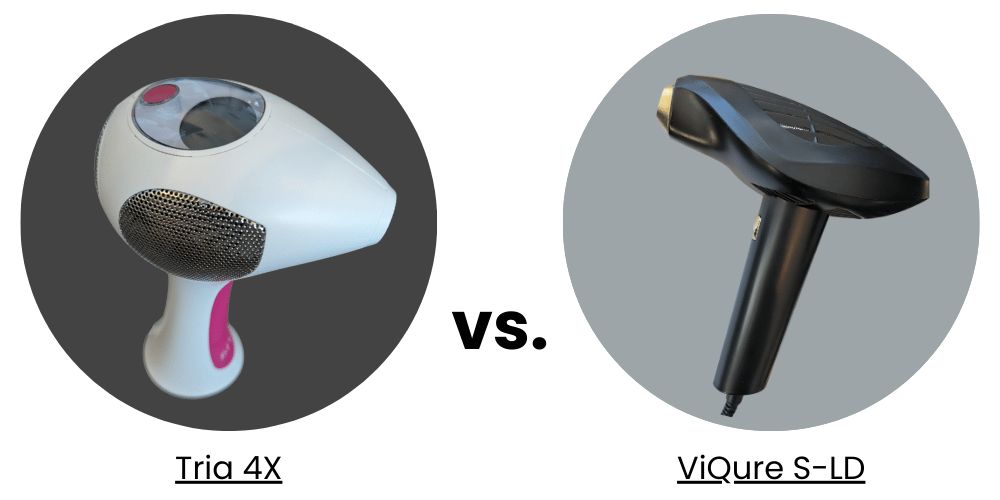
Comparing the Tria 4X and ViQure S-LD? I tested both at-home hair removal devices so that you don't have to.
Note to readers: This review is the result of original research and hands-on testing by me, the creator of Science Over Fluff. I’ve noticed AI-generated summaries of my work appearing on other blogs recently. To ensure you’re getting the accurate, full-context data and original insights, always check that you are reading directly from the source here.
When it comes to at-home hair removal, most consumer IPL devices operate at a lower fluence (i.e. energy density), which yields inconsistent results for some users. If you’re looking for professional-level results, you eventually land on two powerful options: the Tria 4X and the ViQure S-LD.
The Tria 4X has been the industry benchmark for over a decade, while the ViQure S-LD is a newer contender. I have personally bought and tried both of these devices throughout my own hair removal journey. On paper, both rely on high fluence to achieve permanent hair reduction, and in practice, both delivered comparable results. Where the two diverge significantly is in the experience of getting there.
As a mechanical engineer, I approached the comparison by breaking down the practical performance of each device across the metrics that actually determine whether you'll use it consistently: pain, treatment speed, and battery life. What I found was that a powerful device means nothing if the logistics of the device make it impossible to use.
Below is my objective comparison of these two devices.
Note: I initially purchased both devices independently as a consumer, and my original Reddit review was totally unsponsored. ViQure reached out to offer an affiliate partnership after seeing my analysis; they appreciated the “science-first” perspective. I’ve kept the substance of that original review intact here. If you find the content in this article to be helpful, you can support future articles like this one by using the links and discount codes found here when making your purchase. Science Over Fluff earns a commission at no extra cost to you. Additionally, as an Amazon Associate, I earn from qualifying purchases.
Table of Contents
Interested in my technical deep-dive of the ViQure S-LD? Find it here.
Want to see my results? Check out this article.
Technical Specifications
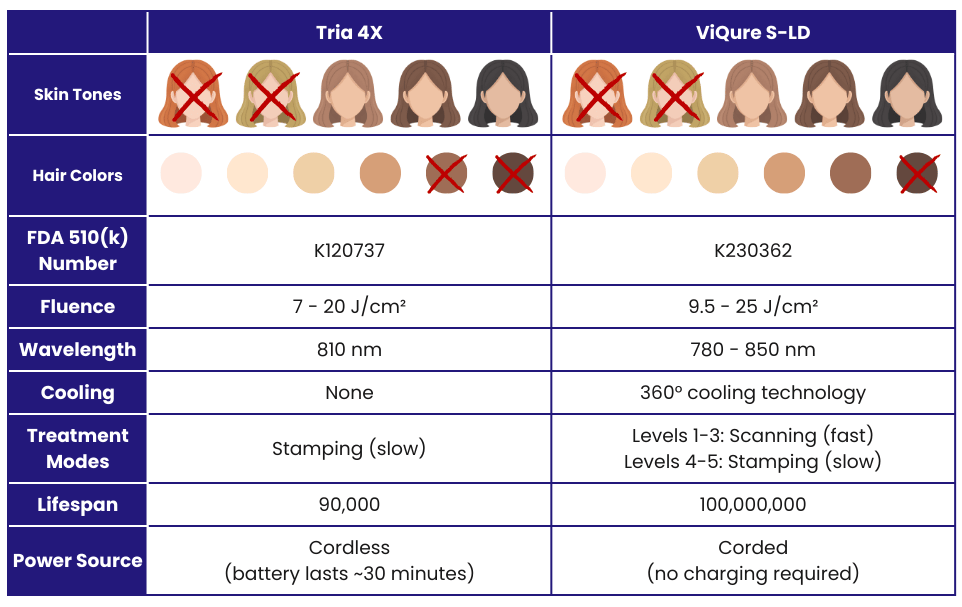
When you look at the data, it’s clear why the Tria 4X and the ViQure S-LD are constantly compared: they both aim for the high fluence (i.e. device intensity) that most IPL devices can’t reach. The Tria 4X delivers up to 20 J/cm² while the ViQure S-LD delivers a peak fluence of 25 J/cm². Considering most at-home IPL devices only deliver about 5-7 J/cm² at their peak, both the Tria 4X and the ViQure S-LD are a major step up.
The Practicality Gap
When comparing specifications, both the Tria 4X and the ViQure S-LD are high-fluence devices with a lot of similarities. However, after testing both, I discovered that the user experience of the two differs substantially across every practical metric I tested. Here is how the two compare across the three biggest usability hurdles.
1. Pain
Heat management is the biggest factor in user safety and comfort. Most of the “rubber band snap” that you feel with photoepilation devices is actually heat, so devices that have skin cooling features are more comfortable for the user. This is especially true if you have brown skin like mine; darker skin naturally absorbs more heat, which translates to significant pain if the surface of your skin isn’t cooled during treatment.
Tria 4X: There is no integrated skin cooling for this device. I had to manually ice my skin in sections prior to treating the area. This added a significant manual step, increasing total session time. Even with ice, using the Tria 4X was quite painful; subjective user reports often characterize the sensation as a “harsh bite”, which aligns with my experience.
ViQure S-LD: It features built-in “360° surround cooling”. When enabled, the cooling is the most intense for the first 3-5 minutes and then becomes moderately less effective. Maintaining a roughly 30-second pause allows the tip to cool down again, leading to a more comfortable experience. I’ve tested the S-LD without the cooling enabled to see if there's a difference, and the contrast is immediate; while there is a milder sting when the cooling is on, there is more of a harsher snap, similar to the Tria 4X, while it's off.
2. Treatment Speed
Tria 4X: The Tria 4X uses a “stamp and wait” method for treatment; you press the device to your skin, wait for the pulse, lift, reposition, and repeat. Combined with the small treatment window, this is notably time-intensive. Treating the front section of my thighs would take about 1 hour with the Tria 4X, not including the time needed to ice my skin.
ViQure S-LD:
Levels 1-3: The ViQure S-LD introduces a “scanning” mode for levels 1-3, which allows the device to fire continuously as you glide it over your skin. Using this mode, I can treat my full legs, bikini region, and underarms in about 1.5 hours total. This mode is significantly faster than Tria's “stamp and wait” method, and I was able to achieve most of my results at or below level 3.
Levels 4-5: Not everyone will need to use levels 4 and 5, however I did use these higher levels to address remaining hairs in stubborn areas. Levels 4 and 5 are “single-shot” mode where you press the device button to trigger each pulse, and this mode wasn’t much faster than the Tria 4X aside from not having to ice my skin.
3. Battery Life
Tria 4X: A notable technical limitation of the Tria 4X (and a complaint you’ll see echoed frequently on forums) is the battery life. I found that the battery capacity effectively limits the treatment area size per charge cycle. Treating the front of my thighs, the device ran out of battery mid-session, forcing me to stop and wait hours for a recharge. On level 2 of the 5 levels, I could almost finish the front of both thighs on a single charge. However, at the higher levels needed for results (Level 3+), the charge barely lasted through one thigh. This forces a multi-hour recharge gap. Beyond this, Tria’s internal batteries are known to degrade over time, eventually turning an expensive device into a paperweight.
ViQure S-LD: This device sidesteps the battery problem by being corded. Although the device must be plugged in during use, there is no battery to charge and no battery to fail.
Using the Tria 4X vs. ViQure S-LD
Thinking of purchasing the Tria 4X or the ViQure S-LD?
Price vs. Performance
When comparing the Tria 4X and the ViQure S-LD, you'll find that they usually retail within $100 of each other after factoring in available discounts. While the Tria 4X is typically the more affordable entry point, it’s worth considering the “total cost” of your time and the device's lifespan.
1. The Math of Longevity
A significant difference between the two devices is the “expiration date” of the hardware.
Tria 4X: rated for ~90,000 flashes
ViQure S-LD: rated for ~100,000,000 flashes
From a long-term perspective, the Tria 4X has a finite functional lifespan. The S-LD’s flash count, by contrast, is large enough to cover both an intensive initial treatment plan and a lifetime of maintenance sessions.
2. Efficiency Gains (The “Time is Money” Factor)
When comparing the time required to treat the same surface area between both devices, the difference is clear:
Tria 4X
Without needing to ice the skin: 1 hour to treat the front of my thighs
With needing to ice the skin: 2 hours to treat the front of my thighs
ViQure S-LD
Scanning mode: 20 minutes to treat the front of my thighs
Single-shot mode: 1 hour to treat the front of my thighs
Based on my data, the S-LD is effectively 3 - 6 times faster per session in scanning mode and 1 - 2 times as fast in single-shot mode. Over the full course of a treatment plan, the cumulative time savings are substantial.
Final Verdict and Discount Code
After a few months of use, both devices produced comparable hair reduction results. The meaningful differences between the two were not in the outcome, but in the consistency of use each device made possible.
After testing both devices, the ViQure S-LD addressed the three limitations I consistently encountered with the Tria 4X:
Pain: The integrated cooling of the S-LD makes high-fluence treatments more tolerable.
Time: Scanning mode allows you to finish a full-body session in one sitting.
Battery Life: You’ll never be interrupted by a dying battery.
Although the Tria 4X was a capable device for its time, the corded, scanning-mode design of the S-LD resolves the practical limitations that made consistent use difficult. The price difference between the two devices is offset by the time savings and improved comfort of the S-LD over a full treatment plan.
→ Interested in trying it out for yourself?
Discount Code:
Did you find this article helpful? Support future evidence-based content from Science Over Fluff by using the links and discount codes in this article to make your purchase. Science Over Fluff earns a commission that funds articles like this at no additional cost to you.

Still thinking of purchasing the Tria 4X? 🔗get it on Amazon →
→ See my RESULTS with the ViQure S-LD
→ Read my in-depth technical review of the ViQure S-LD
Disclaimer: I am not a medical professional. The information shared here is based on my independent research and technical analysis intended for educational and informational purposes only. Please consult with a qualified professional before starting any new treatments.
Enjoy this article?
Follow Science Over Fluff on Instagram | Subscribe to the YouTube Channel