

If you have rosacea and you’ve been looking into at-home light-based devices, you’ve probably run into LED masks and laser options marketed for skin rejuvenation. However, very few of them were designed with rosacea redness in mind, and most reviews never explain why that matters.
In a clinical setting, pulsed dye lasers (PDL) producing yellow light are the gold standard for visible redness and broken capillaries, though some studies have found clinical IPL can produce comparable results. If you have access to a dermatologist offering laser treatments and cost isn’t a barrier, clinical lasers are the more established route for rosacea. However, if you’re exploring at-home devices, there is no such yellow laser equivalent, with most devices producing light in the red, near-infrared, or blue range. Notably, yellow light is often missing.
This article goes through the research on light-based approaches for rosacea-prone skin and uses it to rank the at-home devices that are actually worth considering — most of which cost a fraction of in-clinic treatments.
Note: After identifying the most relevant devices based on the research, I reached out to companies to establish affiliate partnerships. If you find this article helpful, you can use the links and discount codes here to support future content like this. Science Over Fluff may earn a commission at no extra cost to you.
Table of Contents
Quick Summary
According to the research, the following parameters have been shown to improve the appearance of rosacea redness.
Yellow light (~570–600nm)
Targets surface level redness and superficial blood vessels.
Near-infrared light in the ~850nm+ range
Targets deeper blood vessels and broken capillaries (vascular lesions).
While other wavelengths of light can work for rosacea, they are not as targeted and will not be as effective at the same energy (fluence). They may also produce additional heat, reducing comfort.
Device Recommendations
Types of Rosacea
There are four recognized types of rosacea. Because at-home light devices operate at a significantly lower energy than in-clinic treatments, they are relevant primarily to reducing redness in types 1, 2, and 3. Type 4 is near the eyes — a zone that consumer devices are not designed for.

Type 1: Vascular rosacea
Persistent facial redness, sometimes with visible veins (broken capillaries)

Type 2: Inflammatory rosacea
Red bumps alongside facial redness

Type 3: Phymatous rosacea
Thickened, bumpy skin texture, most commonly around the nose
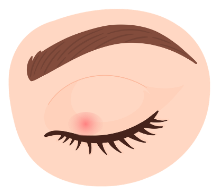
Type 4: Ocular rosacea
Redness and inflammation affecting the eyelids
Can Light Actually Improve the Appearance of Rosacea?
The short answer is yes, with the right wavelengths. Light travels in waves, and “wavelength” refers to the length of the wave between two consecutive peaks. Human eyes perceive different wavelengths as different colors of light, though wavelengths extend far beyond what the eye can see. Different wavelengths penetrate to different depths of tissue and are absorbed by different targets, called chromophores, within the tissue.

In rosacea, the target is hemoglobin. The redness associated with rosacea comes from dilated or damaged blood vessels. Hemoglobin is the protein in red blood cells that gives them their color — and it's the chromophore that matters here. When hemoglobin absorbs light energy, that energy converts to heat, which causes the blood vessel wall to coagulate and the vessel to constrict, reducing the visible redness above it.
Simply put, when it comes to light-based devices, there are two factors at play:
The selected wavelength of a light-based device must be able to penetrate deep enough to reach blood vessels.
Not all wavelengths are absorbed by hemoglobin at the same rate.
Optimizing light to target rosacea comes down to which wavelengths can address both mechanisms simultaneously.
Which Wavelengths Penetrate the Deepest?
Not all wavelengths penetrate skin equally. Shorter wavelengths of light scatter heavily and get absorbed before reaching deeper. Longer wavelengths travel further into the skin before being absorbed. This matters for rosacea because blood vessels sit at different depths. Fine surface capillaries are close to the skin surface, while larger, more established vascular lesions sit further into the dermis.
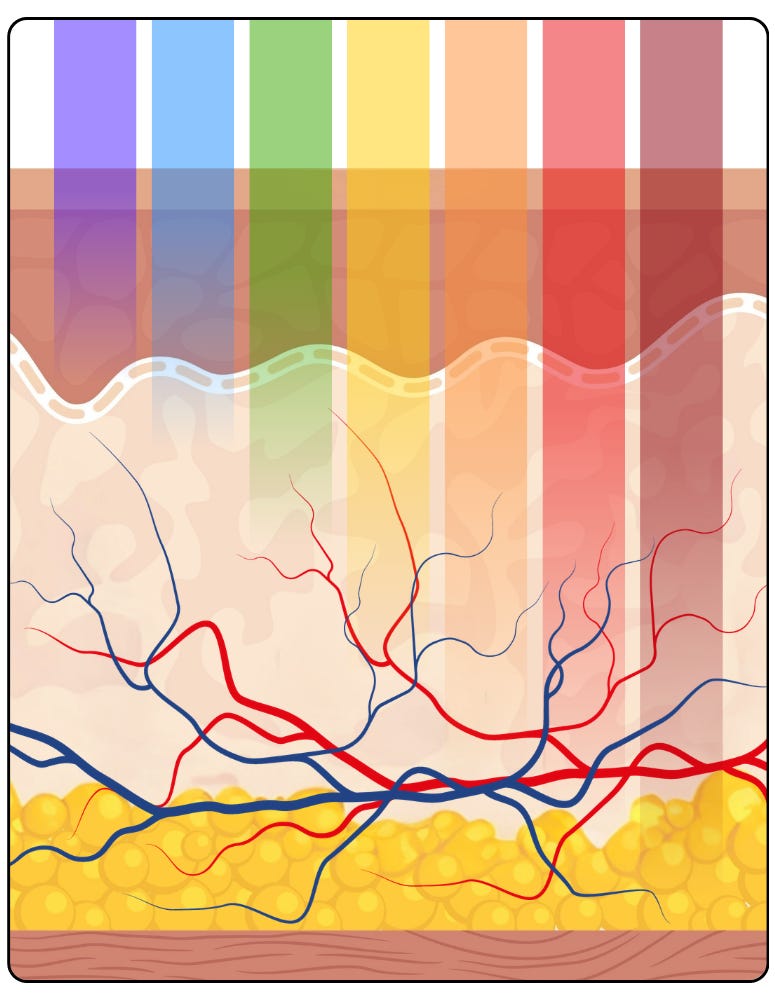
A device that only emits short wavelengths cannot reach the deeper vessels. Yellow light is able to reach blood vessels closer to the surface of the skin, while red and near-infrared light can penetrate further down. However, penetration depth is only one half of the equation.
Which Wavelengths Does Hemoglobin Actually Absorb?
Hemoglobin absorbs light across a wide range of wavelengths, but not all equally. Lower wavelengths, 600nm and less in particular, are more readily absorbed by hemoglobin. However, since lower wavelengths do not penetrate deep enough to reach blood vessels, the shortest wavelengths are not relevant for rosacea. Yellow light at roughly 570–600nm hits the sweet spot. It penetrates deep enough to reach surface-level vessels and absorbs into hemoglobin far more efficiently than red or near-infrared light. This is why pulsed dye lasers emitting at 585–595nm (yellow) are the clinical gold standard for visible redness and broken capillaries.
Hemoglobin absorption drops off significantly for red light, but doesn’t disappear entirely. In the near-infrared range, absorption increases again, though it still has lower absorption than yellow light. Combined with greater penetration depth, near-infrared wavelengths can produce sufficient thermal effect to coagulate deeper vessels that yellow light can’t physically reach.
These are two distinct mechanisms working together: yellow light addresses surface redness via preferential hemoglobin absorption, while near-infrared light addresses deeper vascular structure via penetration depth.
Why At-Home Devices Usually Miss the Mark — and Why IPL Doesn’t
Lasers and LEDs inherently emit light at wavelengths that are targeted, meaning they emit only one color of light per diode. Because of this, laser and LED-based home devices are designed to emit red, blue, and near-infrared light that target the most common skin concerns such as wrinkles and acne. These are deliberate design choices for those applications, not limitations of the technology itself. The result is that most at-home lasers and LED masks produce little to no yellow light, which is precisely what rosacea redness responds to best.
IPL (intense pulsed light) works differently. It emits a broad "rainbow" spectrum, typically 500nm to 1200nm, in a single short burst. That short duration is why IPL can feel more intense than LED; light energy delivered rapidly is generally less comfortable than when delivered gradually. While this makes IPL less useful for some photorejuvenation applications, it's actually a good fit for rosacea redness because that broad spectrum naturally includes both yellow and near-infrared light.
IPL can be further optimized with filters that block unnecessary wavelengths and concentrate output where it matters most. Since red-range wavelengths aren't absorbed by hemoglobin as efficiently, filtering them out reduces the heat sensation and improves comfort. A well-filtered IPL device therefore addresses both mechanisms simultaneously: yellow output for surface hemoglobin absorption, and near-infrared output for deeper vessel penetration.
At-Home Device Recommendations
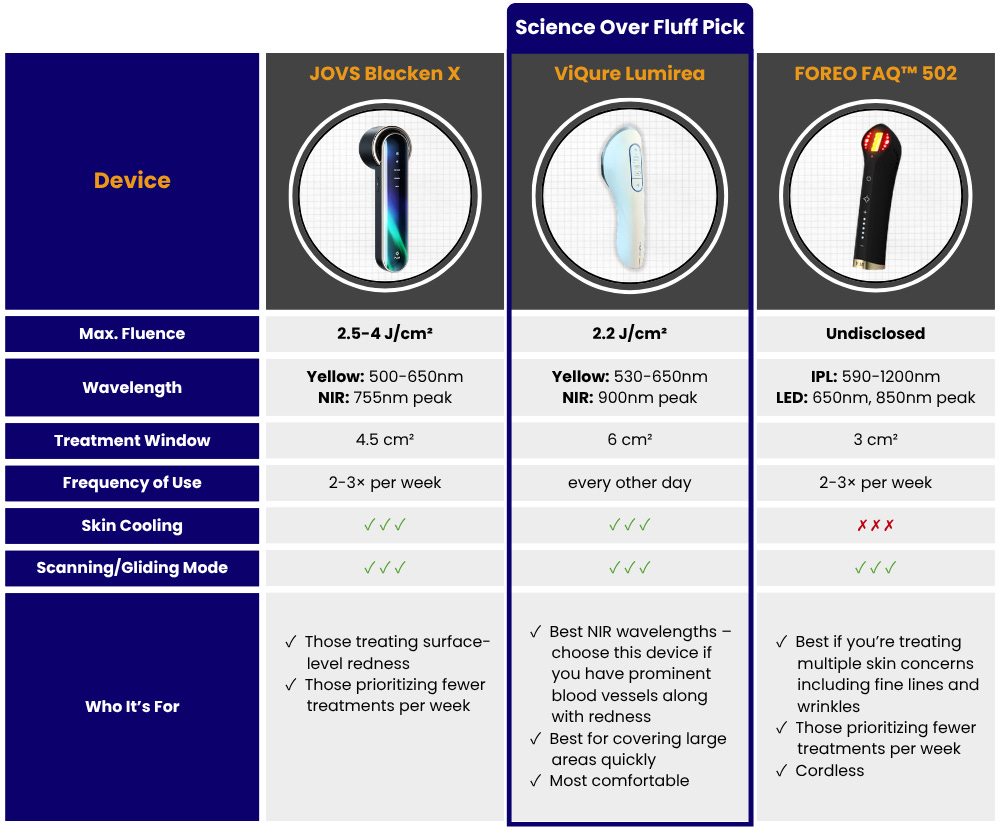
The devices below were evaluated based on their emissions in the yellow range, whether they cover the correct near-infrared wavelengths, and their treatment area. Fluence (energy per unit area, measured in J/cm²) is included where the manufacturer publishes it.
Top Pick
Lumirea by ViQure

Yellow wavelengths: 530–650nm
Near-Infrared wavelengths: 900nm peak
Fluence: 2.2 J/cm²
Treatment Area: 6 cm²
The Lumirea earns the top spot due to emitted wavelengths and treatment area size. Its IPL filters concentrate output in two distinct bands: yellow (530–650nm) and near-infrared (900–1800nm), filtering out the 650–900nm middle range that contributes to heating. The near-infrared band peaks at 900nm for deeper vascular lesions — meaning it addresses the penetration depth mechanism directly. Combined with a 6 cm² treatment window, it covers more ground per flash than competing devices.
Exclusive reader discount: Use code ‘SOF60’ at checkout to get $60 OFF
Runner-Up
JOVS Blacken X

Yellow wavelengths: 500–650nm
Near-Infrared wavelengths: 755nm peak
Fluence: 2.5-4 J/cm²
Treatment Area: 4.5 cm²
The JOVS covers the essential wavelength range for superficial vessel targeting and has a higher fluence (2.5–4 J/cm²) than the Lumirea on paper. The catch: its near-infrared wavelengths peak at 755nm, which is on the lower end for deep vessel coagulation. Nonetheless, the JOVS Blacken X is a solid runner up.
Also Worth Considering
FAQ™ 502 by FOREO

Wavelengths: 590–1200nm
Treatment Area: 3 cm²
The FAQ™ 502 combines IPL with dedicated LED output. Its IPL wavelengths start at 590nm, capturing yellow through near-infrared. The LED component peaks at 650nm and 850nm, producing additional skin rejuvenation effects. These are genuinely different mechanisms in one device. The tradeoff: its IPL isn’t filtered, so the output is less concentrated around vascular-targeting wavelengths. Worth considering if you want redness relief alongside other benefits such as anti-aging.
Exclusive reader discount: Use code ‘SOFX30’ at checkout to get 30% OFF
A Note on Expectations
At-home devices operate at lower fluences than the clinical devices used in the studies referenced here — professional machines typically use 10 J/cm² or above. That gap matters. At-home devices are underpowered by design, which is part of what makes them safer for unsupervised use. The tradeoff is that you compensate with more frequent sessions over a longer period. For many people, consistent at-home use over several months produces a noticeable improvement in the appearance of redness at a fraction of the cost of repeated clinic visits — and with considerably less discomfort per session.
Results will vary based on skin tone, vessel depth, and rosacea subtype. If your rosacea is severe or you have ocular rosacea, a dermatologist is the right starting point.
The Bottom Line
Wavelength selection matters more than brand names or marketing claims when choosing a light device for the appearance of rosacea redness. Most LED masks weren’t built for this — they’re acne or anti-aging devices first, and the wavelengths they emit reflect that. Of the at-home categories available, IPL is currently the only one that naturally covers yellow and near-infrared light, the two ranges with real research behind them for vascular rosacea.
Among the devices recommended here, the differences come down to spectral filtering, treatment area, and fluence. The Lumirea’s dual-band DPL filtering concentrates output where it matters most for vascular targeting. The Blacken X offers higher energy but peaks at a lower near-infrared range. The FAQ™ 502 trades some spectral concentration for multi-purpose versatility, with its LED component adding skin rejuvenation effects alongside the IPL.
All three require consistent use and realistic expectations. At-home fluences are lower than that of clinical machines, and progress happens over weeks rather than sessions. For many people with rosacea-prone skin, that tradeoff — lower cost, lower discomfort, done at home — is exactly the point.
→ Interested in trying them out for yourself? Get them here:
Disclaimer: While I am an engineer and enjoy breaking down the science of how technology works, I am not a medical professional. The information shared here is based on my independent research and technical analysis intended for educational and informational purposes only. Please consult with a qualified professional before starting any new treatments.
Enjoy this article?
Follow Science Over Fluff on Instagram | Subscribe to the YouTube Channel