Best Hair Growth Caps 2026: Research Reveals Which Ones Actually Work
A data-driven guide to FDA-cleared laser and LED hair growth helmets and caps based on research.
Feb 13, 2026
Finding a reliable hair growth cap is a frustrating process of navigating conflicting claims and misleading marketing. While clinical research confirms that hair growth caps can be an effective tool for treating male and female pattern hair loss (androgenic alopecia), the industry is currently saturated with inconsistent information. Digging through research papers is tedious and feels inaccessible for most people. I’ve written this guide to do that heavy lifting for you, cutting through the noise to show you exactly what the data says about what works.
Hair growth caps aren’t a fix for every kind of hair loss. They won’t address shedding caused by nutritional deficiencies or systemic health issues. However, for pattern hair loss specifically, they represent one of the more promising non-invasive treatments available today. Research suggests that these devices offer a similar level of effectiveness to 5% topical minoxidil, making them a potent drug-free alternative. This is particularly relevant for those wary of drug-related side effects, such as the persistent sexual or neurological symptoms associated with post-finasteride syndrome (PFS). When used correctly, hair growth caps have been clinically shown to not only increase hair count but also improve individual strand thickness. When you consider other treatments like Minoxidil can be over $200-$300 per year, hair growth caps and helmets are also the better long-term pick for your wallet.
Every device reviewed in this article is FDA-cleared. That clearance matters because it confirms the device is “substantially equivalent” to legally marketed hardware in both safety and efficacy. Choosing an uncleared device means testing unverified hardware on your scalp with no regulatory oversight.
Disclosure: Editorial integrity is the top priority at Science Over Fluff. The recommendations in this guide are the result of independent technical analysis. After identifying the most effective devices based on clinical data, I reached out to the respective companies to establish affiliate partnerships that supports the continued production of articles like this one. If you use the links in this article to make a purchase, Science Over Fluff may earn a commission at no extra cost to you. Additionally, as an Amazon Associate, I earn from qualifying purchases.
Priced in the mid-tier range, this device outperforms more expensive “premium” models. The design mimics the parameters used in the landmark clinical trial that achieved the highest hair regrowth results in the literature.
A cost-conscious option that hits the 90-minute weekly treatment target. The irradiance is slightly below the 2 to 3 mW/cm² range identified in the research, but its gentle output avoids the overstimulation risk that can come with higher-powered devices.
✦ Reader Discount: Use code ‘SOF50’ for $50 OFF
What the Science Says
Do Hair Growth Caps Actually Work?
Yes, the clinical data confirms that hair growth caps work, but only if the device delivers light via the correct parameters. Hair growth caps work through a process known as Low-Level Light Therapy (LLLT), which is also referred to as “photobiomodulation”. The therapy promotes hair regrowth through a few primary mechanisms:
Cellular Energy: Red and near-infrared light is absorbed by specific enzymes within your cells. This accelerates the production of ATP (the primary energy molecule) which gives hair follicles the fuel needed to grow.
Inflammation and Hormones: LLLT increases signaling molecules to calm follicle inflammation, preventing tissue scarring that physically shrinks and shuts down hair production. It also helps protect dermal papilla cells from DHT, the hormone responsible for thinning.
Blood Flow: Light triggers the release of nitric oxide, a gas that acts as a vasodilator to widen blood vessels. This carries more oxygen and nutrients to the root.
Together, these mechanisms help transition dormant follicles into a sustained growth state while supporting the underlying health of the scalp. However, understanding the biology is only part of the picture. For the therapy to work, the light has to be delivered at the right schedule and intensity.
When I looked at the clinical data, a clear set of patterns emerged around the parameters that actually drive regrowth. Importantly, the studies I reference below focus exclusively on results from helmet and cap devices used without pharmaceutical support. By excluding data that combined LLLT with Minoxidil or Finasteride, it’s possible to isolate a device’s actual effectiveness without the confounding influence of drug intervention.
Treatment Times
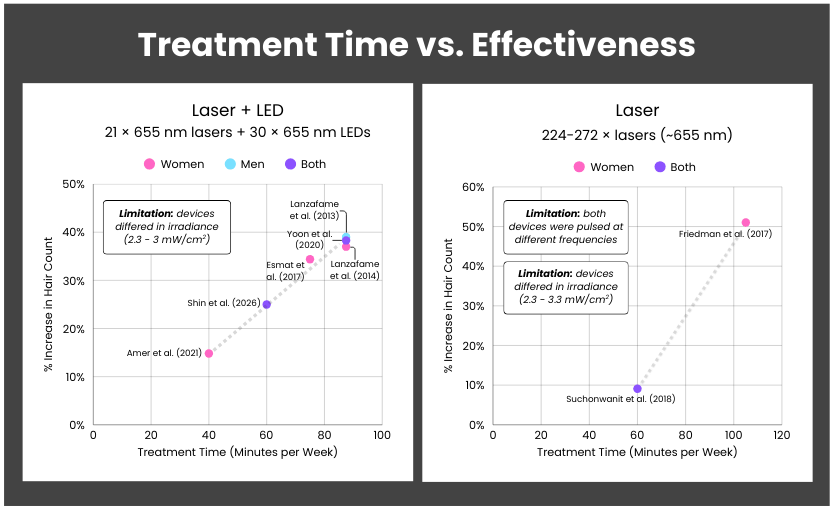
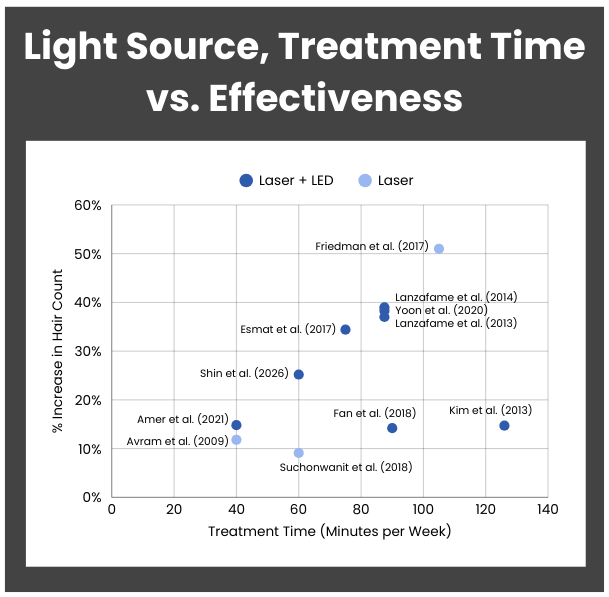
To compare devices on equal footing, I looked at studies using similar energy dose rates and light sources side by side.
The data shows a consistent pattern: caps and helmets used for longer treatment times, within the ranges tested across these trials, generally produced better results. This held true regardless of whether the device used lasers only or a laser/LED combination, and regardless of the gender of participants.
That said, it would be a mistake to assume that more time automatically translates to more hair growth. LLLT relies on delivering the right energy dose, not the maximum one. Research shows that while low doses are ineffective, excessive energy can actually inhibit the very growth you are trying to stimulate. Wearing a device for hours won’t necessarily give you better results; current clinical data only confirms a benefit for usage up to approximately 105 minutes per week and exceeding this threshold puts you in unproven territory.
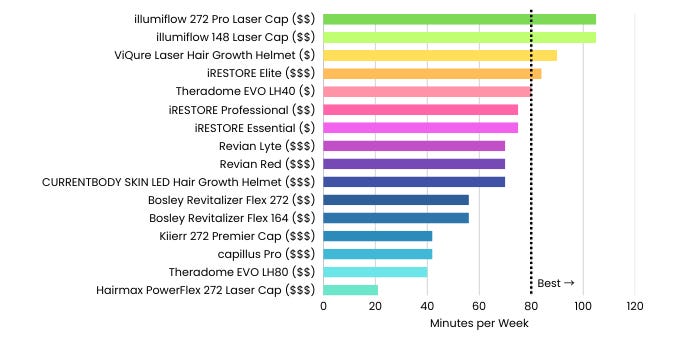
Using these findings, I ranked available devices by how closely their weekly treatment time lands in that 80 to 105 minute target zone.
Laser and LED Hair Growth Devices Ranked by Treatment Time
Why More Powerful Hair Growth Caps Are Often Less Effective
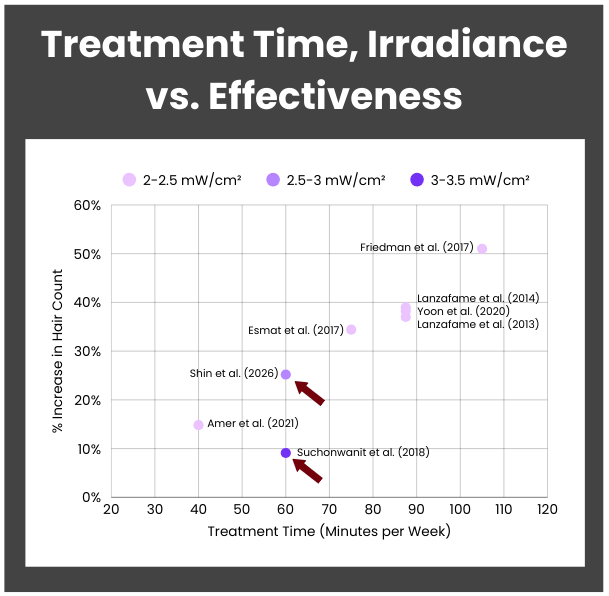
The rate at which the scalp receives light energy is called “irradiance”. The data here is counterintuitive: as irradiance increases, effectiveness actually decreases. This is particularly evident when looking at the 2018 and 2026 trials indicated by the arrows in the chart below. Both used identical treatment durations, but the 2026 trial used a lower irradiance and outperformed the 2018 trial by roughly 15%.
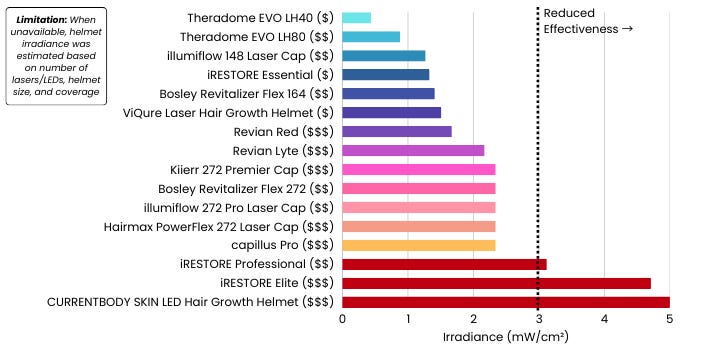
Based on this negative correlation, I filtered out devices with irradiances above 3 mW/cm².
Laser and LED Hair Growth Devices Ranked by Irradiance
Laser vs. LED Hair Growth Caps: Does It Actually Matter?
The debate between using lasers versus LEDs in LLLT is a central topic in the industry. The traditional argument in favor of lasers is that their focused, coherent light can penetrate deeper into the follicle than the diverging light produced by LEDs. However, current research suggests that the biological response of the hair follicle may be similar regardless of which light source is used. Studies on LED-only caps are still limited, but data from laser/LED hybrid devices shows performance levels comparable to all-laser systems.
In an interesting twist, one finding from the Suchonwanit et al. study is worth noting here. The study was testing a laser-based device and used low-powered LEDs in a placebo device designed to look like the real thing. Even with those placebo LEDs running at roughly one-tenth the normal intensity, the placebo device still produced an increase in hair count of about 3.4%. It’s a small but meaningful data point suggesting that even modest LED output can trigger a measurable follicle response. Specific outcomes will vary, but the data supports the conclusion that both technologies can successfully initiate hair growth.
The Takeaway
Based on the clinical data analyzed, the most effective hair growth caps follow these patterns:
Treatment Duration: Devices with longer weekly treatment times perform better within the ranges tested, though clinical data only extends to approximately 105 minutes per week.
Energy Intensity: Caps with an irradiance between 2-3 mW/cm² are generally more effective than high-intensity alternatives.
Hardware Type: There is no significant performance difference in results between all-laser and laser/LED hybrid devices.
Short-duration helmets may seem appealing because of their convenience, but the ability to follow a longer-duration, lower-intensity regimen is what the research supports for sustained physiological results. Follicles respond better to consistent, gentle stimulation than to concentrated bursts.
Note: As of early 2026, hair growth caps and helmets are currently FDA cleared only for Fitzpatrick skin types I through IV. More research is needed to establish efficacy on darker skin tones (V-VI).
Best Hair Growth Devices According to Science
Based on the metrics of time and intensity, there are a few devices that seem to have close to optimal parameters. However, I’ve narrowed the options down to two standout devices that most closely align with the winning specifications found in the research.
Illumiflow 272 Pro: The Science-First Pick
→ BONUS Reader Discount: Use code ‘SOF140’ to get $140 OFF
Case Study: I am currently conducting a trial with the ViQure Laser Hair Growth Helmet on a designated tester to track real-world progress over time. Subscribe to Science Over Fluff to stay updated on the results!
Treatment Stacking (For Those Seeking Faster Results)
While LLLT is a capable standalone treatment, data suggests that stacking it with other proven therapies can act as a catalyst. By addressing hair loss through multiple biological pathways, you can often reach your peak results sooner.
5% Minoxidil (Topical): Minoxidil works as a vasodilator, increasing blood flow to the scalp and extending the active growth phase of the follicle. A 2023 meta-analysis confirmed that combining a hair growth cap with topical Minoxidil frequently produces superior or equivalent outcomes to either of the two therapies used alone. The most notable advantage is speed; clinical observations show that users who combine these treatments see significantly faster regrowth during the first few months, though the final results typically level out over the long term.
Supplements: While the research on micronutrients and hair follicle health is still developing, a meta-analysis found consistent support for vitamin D supplementation in people experiencing hair loss who test as deficient. Similarly, biotin deficiency is a known cause of hair thinning, though it is important to note that taking extra biotin does not appear to produce additional growth benefits once deficiency is corrected.
Note: Consult with a medical professional before starting any new supplement, particularly if you are pregnant, managing a chronic health condition, or taking prescription medications.
Ultimately, whether you choose a standalone hair growth cap or opt to add Minoxidil and targeted supplements, the variable that matters most is consistency. Hair follicles operate on long cycles, and even the most clinically supported treatments require several months of disciplined use before visible changes appear.
Research
Research Criteria
To find the most effective FDA-cleared hair growth caps on the market, this guide looks at studies filtered for real-world relevance. The selection process focused on a few key criteria:
Wavelength: Only devices operating at or near 650 nm.
Device Type: Wearable caps and helmets only. Handheld combs were excluded due to inconsistency across users.
Condition: Data specifically for androgenetic alopecia (pattern hair loss).
Treatment Purity: LLLT-only data. Results combined with Minoxidil or Finasteride were left out to isolate device performance.
Technology: Both all-laser and laser/LED hybrid devices. (Note: Solid data for LED-only devices remains unavailable as of early 2026).
Data Quality: Only studies with quantifiable results (percentage increase from baseline) were included.
Reporting: Where technical data like energy dose was inconsistent, conservative estimates were used where possible.
Disclaimer: While I am an engineer and enjoy breaking down the science behind how technology works, I am not a medical professional. The information shared here is based on my independent research and technical analysis intended for educational and informational purposes only. Please consult with a qualified professional before starting any new treatments.
Enjoy this article?
Stay tuned for the next article by subscribing to the Science Over Fluff Newsletter!